
七言律詩 (Shichigon risshi, Chinese poem in seven-character lines)|Chinese Poem on an Imaginary Landscape
early 17th century
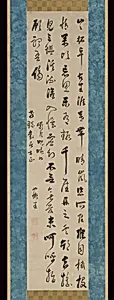
Medium
Hanging scroll; ink on paper
Dimensions
Image: 49 × 10 3/4 in. (124.5 × 27.3 cm) Overall with mounting: 80 3/16 × 17 3/4 in. (203.7 × 45.1 cm) Overall with knobs: 80 3/16 × 20 1/8 in. (203.7 × 51.1 cm)
Classification
Calligraphy
Culture & Period
Japan · Edo period (1615–1868)
Department
Asian Art
Museum
Metropolitan Museum of Art, New York, NY
Credit
Mary and Cheney Cowles Collection, Gift of Mary and Cheney Cowles, 2020
Accession Number
2020.396.7
Rights
Public Domain
Art Historical Context
This exquisite hanging scroll, titled *Chinese Poem on an Imaginary* (七言律詩, or *Shichigon risshi*), created by the Japanese artist Yelan Xingguialso known as Yaran Shōkei, 也嬾性圭) in the early 17th century during Japan's Edo period (1615–1868). Rendered in ink on paper, it exemplifies the refined tradition of literati calligraphy, where poetic text intertwines with evocative imagery. The poem follows the classical Chinese form of seven-character lines (*shichigon risshi*), a structured verse style prized for its rhythmic balance and philosophical depth, often evoking nature's harmony. In Edo-era Japan, such works bridged Chinese scholarly traditions with Japanese aesthetics, reflecting the era's cultural flourishing under the Tokugawa shogunate. Hanging scrolls like this were not everyday objects but treasures unrolled for intimate gatherings, allowing viewers to immerse themselves in the artist's imaginary landscape—a misty, ethereal vista that complements the poem's contemplative mood. The use of ink on paper highlights masterful control of brushwork, from bold, flowing characters to subtle washes, embodying *wabi-sabi* restraint and Zen-inspired simplicity. Today, housed in the Metropolitan Museum of Art's Asian Art Department as part of the Mary and Cheney Cowles Collection, this piece invites us to pause and ponder: how does a single scroll capture the boundless imagination of East Asian poetry and painting?