
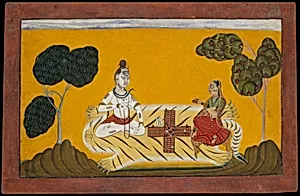
Shiva and Parvati Playing Chaupar: Folio from a Rasamanjari Series
dated 1694–95
Medium
Opaque watercolor, ink, silver, and gold on paper
Dimensions
Image: 6 1/2 x 10 7/8 in. (16.5 x 27.6 cm) Sheet: 8 x 12 1/4 in. (20.3 x 31.1 cm) Framed: 15 5/8 x 20 1/2 in. (39.7 x 52.1 cm)
Classification
Paintings
Culture
India (Basohli, Jammu)
Department
Asian Art
Museum
Metropolitan Museum of Art, New York, NY
Credit
Gift of Dr. J. C. Burnett, 1957
Accession Number
57.185.2
Rights
Public Domain
Tags
Art Historical Context
This exquisite folio, painted by Devidasa of Nurpur in1694–95, captures the divine couple Shiva and Parvati absorbed in a game of chaupar, an ancient Indian board game. Created in theohli region of Jammu the Pahari hills the work belongs to theamanjari series a celebrated cycle of paintings illustrating the emotional nuances of love drawn from a 15th-century Sanskrit text. Here, the gods appear in a tender, almost human moment, their playful interaction symbolizing harmony and devotion within Hindu mythology. Devidasa worked in the distinctive Basohli style, known for its vibrant palette, bold outlines, and flattened perspective that emphasizes emotional intensity over realism. The medium of opaque watercolor, enhanced with gold and silver on paper, allowed the artist to create luminous effects that catch the light, evoking the sacred radiance of the deities. Such details highlight the painting’s role as both devotional object and sophisticated court art. As a folio from an illustrated manuscript, this piece reflects the rich tradition of Indian miniature painting in the late 17th century, where regional workshops blended local aesthetics with influences from Mughal art. Its presence in the Metropolitan Museum’s collection offers visitors a window into the cultural importance of divine love stories in South Asian visual culture.