
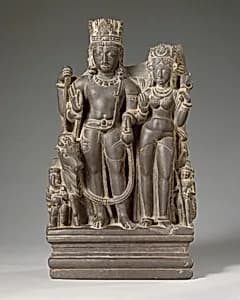
Shiva and Parvati with their Sons Karttikeya and Ganesha and the Calf Bull
Unknown Artist
9th century
Medium
Stone
Dimensions
H. 11 in. (28 cm); W. 6 3/8 in. (16.2 cm)
Classification
Sculpture
Culture
India (Jammu and Kashmir, ancient kingdom of Kashmir)
Department
Asian Art
Museum
Metropolitan Museum of Art, New York, NY
Credit
Gift of Michael and Georgia de Havenon, 1989
Accession Number
1989.362
Rights
Public Domain
Tags
Art Historical Context
This exquisite 9th-century stone from the ancient kingdom of Kashmir in and Kashmir, India, captures a tender family moment among Hindu deities: Shiva, the cosmic destroyer and transformer, seated with his consort Parvati, flanked by their sons Karttik (god of war) and the elephant-headed Ganesharemover of obstacles), and accompanied by Shiva's sacred bull, Nandi—here depicted as a calf. Carved from stone, the compact piece measures just 11 inches high and6⅜ inches wide, suggesting it served as a devotional object for personal worship in temples or homes. Hailing from a golden age of Kashmiri art, this work reflects the region's rich Hindu Shaivite traditions, where intricate stone carving flourished under royal patronage. Kashmir's sculptures often blended Gupta-era influences with local styles, emphasizing graceful figures and symbolic harmony. The familial grouping underscores Shiva and Parvati's role as ideal divine parents, embodying creation, preservation, and devotion central to Hinduism. A gift to the Metropolitan Museum of Art in 1989, this rare survivor invites visitors to ponder the enduring spiritual power of such portable icons, bridging ancient rituals with modern appreciation.