
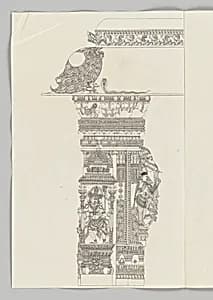
Shiva as Tripsurasamhara; woman holding a flywhisk; rearing yali
ca. 1800
Medium
Ink and wash on J. Whatman paper watermarked 1798
Dimensions
Sheet (folded): 16 1/8 × 10 1/16 in. (41 × 25.5 cm) Sheet: 16 1/8 × 20 1/8 in. (41 × 51.1 cm)
Classification
Paintings
Culture
India, Madurai, Tamil Nadu
Department
Asian Art
Museum
Metropolitan Museum of Art, New York, NY
Credit
Purchase, Friends of Asian Art Gifts, 2021
Accession Number
2021.331
Rights
Public Domain
Art Historical Context
This captivating ink and wash drawing from 1800, originating in Madurai, Tamil Nadu, portrays Shiva in his dynamic form as Tripsurasam—the destroyer of the three cities (Tripura). The fierce god is flanked by a graceful woman bearing a flywhisk (chauri), a symbol of royal service often seen in divine iconography, and a rearingali, a mythical South Indian creature blending lion, elephant, and horse features, evoking power and ferocity. Created on J. Whatman paper watermarked 1798, the folded sheet measures about 16 by 20 inches when unfolded, highlighting an intriguing fusion of European import materials with indigenous artistry during early colonial exchanges. The Tripsurasamhara myth, central to Shaivite Hinduism, celebrates Shiva's triumph over chaos with a single arrow, embodying cosmic renewal—a theme vividly popular in South Indian temple sculptures and paintings from Madurai, a hub of Nayaka-era artistic innovation. The monochromatic ink and wash technique lends a fluid, expressive quality, with subtle tonal washes suggesting movement and depth, typical of preparatory sketches or miniature styles adapted for paper. Housed in the Metropolitan Museum of Art's Asian Art department, this unidentified work underscores Madurai's rich Tanjore painting legacy, where local artists ingeniously incorporated traded papers, bridging worlds and preserving epic narratives for devotees and scholars alike.
About the Artist
Unidentified ( ) · –