
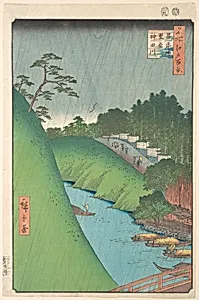
名所江戸百景 昌平橋 聖堂 神田川|Shohei Bridge, Seido Temple and Kanda River
Medium
Woodblock print; ink and color on paper
Dimensions
13 1/4 x 8 3/4 in. (33.7 x 22.2 cm)
Classification
Prints
Culture & Period
Japan · Edo period (1615–1868)
Department
Asian Art
Museum
Metropolitan Museum of Art, New York, NY
Credit
The Howard Mansfield Collection, Purchase, Rogers Fund, 1936
Accession Number
JP2512
Rights
Public Domain
Tags
About this artwork
Utagawa Hiroshige (1797-1858) created this woodblock print during the late Edo period when he established himself as Japan's preeminent landscape artist. His masterful series including "The Fifty-Three Stations of the Tokaido" and "One Hundred Famous Views of Edo" transformed Japanese printmaking by emphasizing atmospheric effects, seasonal changes, and poetic evocation of place. Hiroshige's distinctive approach featured subtle color gradations, innovative cropping and composition, and remarkabl...
Art Historical Context
Utagawa Hiroshige's *Shohei Bridge, Seido Temple and Kanda River* (1857) is a captivating woodblock print from his series *One Hundred Famous of Edo*, celebrating the landmarks of Japan's bustling capital during the late Edo period (1615–1868). This scene captures the Shohei Bridge spanning the Kanda River, the Seido Temple in, alive with human figures, boats, and the gentle patter of rain. Hiroshige, Japan's preeminent landscape artist, transformed everyday topography into poetic visions, emphasizing harmony between people and nature amid rapid urban change. Hiroshige's mastery shines in his subtle color gradations, innovative cropping, and atmospheric effects—here evoking a moody, rainy day through simplified forms and lyrical composition. Unlike Hokusai's dramatic vistas, his gentler style used woodblock printing's collaborative process, where designers, carvers, and printers layered inks for vibrant depth on paper (13¼ × 8¾ in.). This ukiyo-e technique made art accessible to all classes, idealizing Edo's beauty for a changing society. Hiroshige's influence reached the West, inspiring Van Gogh's copies, Whistler, and Impressionists with flattened space and bold colors. At the Metropolitan Museum of Art (The Howard Mansfield Collection, 1936), this print invites you to savor Edo's essence—a timeless blend of observation, imagination, and technical brilliance.
About the Artist
Utagawa Hiroshige · 1826–1869
Utagawa Hiroshige (1797–1858), born Andō Tokutarō, was the last great master of Japanese ukiyo-e woodblock printmaking and one of the most influential landscape artists in history. Born in Edo (modern Tokyo) into a low-ranking samurai family serving as fire wardens, Hiroshige transformed landscape printmaking into a poetic meditation on nature, weather, and everyday life. His revolutionary approac...