
Short Sword (Yatagan) from the Court of Süleyman the Magnificent (reigned 1520–66)
ca. 1525–30
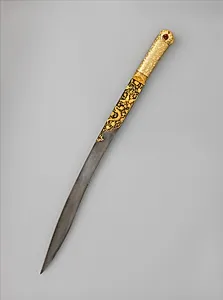
Medium
Steel, gold, ivory (walrus), silver, turquoise, pearls, rubies
Dimensions
L. 23 3/8 in. (59.3 cm); L. of blade 18 3/8 in. (46.7 cm); Wt. 1 lb. 8 oz. (691 g)
Classification
Swords
Culture
Turkish, Istanbul
Department
Arms and Armor
Museum
Metropolitan Museum of Art, New York, NY
Credit
Purchase, Lila Acheson Wallace Gift, 1993
Accession Number
1993.14
Rights
Public Domain
Tags
Art Historical Context
This exquisite yatagan, or short sword, crafted by the renowned Ottoman armorer Ahmed Tekelü around 1525–30, hails from the glittering court of Süleyman the Magnificent (r. 1520–66). During Süleyman's reign, the Ottoman Empire reached its zenith of power and artistic splendor in Istanbul, blending military might with unparalleled luxury. As a ceremonial weapon rather than a battlefield tool, this piece exemplifies the era's fusion of functionality and opulence, reserved for elite warriors and dignitaries. Forged from high-quality steel with a sharply curved blade measuring 18⅜ inches, the yatagan is lavishly adorned using techniques like gold damascening, koftgari inlay, and gemstone setting. Its hilt features walrus ivory grips inlaid with silver, turquoise, pearls, and rubies, while motifs of birds and dragons—symbols of power, protection, and imperial authority—evoke the fantastical bestiary of Persianate and Islamic art traditions. Weighing just over a pound, its ergonomic design highlights masterful balance and ergonomics prized in Ottoman arms. Acquired by The Metropolitan Museum of Art in 1993, this yatagan offers a window into the cultural prestige of 16th-century Istanbul, where weapons doubled as status symbols and diplomatic gifts, reflecting the empire's cosmopolitan influences from Europe to Asia.