
Shu
Unknown Artist
332–30 B.C.
Medium
faience
Dimensions
H. 10.6 cm (4 3/16 in.); W. 7.2 cm (2 13/16 in.); D. 3.4 cm (1 5/16 in.)
Classification
Shu
Period
Ptolemaic Period
Department
Egyptian Art
Museum
Metropolitan Museum of Art, New York, NY
Credit
Rogers Fund, 1953
Accession Number
53.122
Rights
Public Domain
Art Historical Context
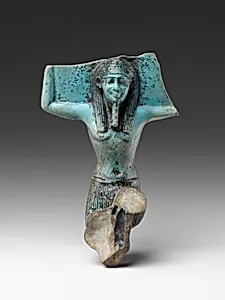
Behold the delicate faience figurine of *Shu*, a masterful creation from Egypt's Ptolemaic Period (332–30 B.C.), when Greek rulers blended with ancient traditions. Standing just 10.6 cm tall, this vibrant blue-green glazed ceramic captures the god of air and wind, a primordial deity who separated the sky goddess Nut from the earth god Geb, ensuring cosmic balance. Crafted by an unknown artist, its compact dimensions (H. 10.6 cm; W. 7.2 cm; D. 3.4 cm) suggest it served as a votive offering or personal amulet, invoking Shu's protective breath of life. Faience, a signature Egyptian medium of crushed quartz glazed to mimic precious stones like lapis lazuli, symbolizes eternity and the Nile's fertile hues. During the Ptolemaic era—named for the Greco-Egyptian dynasty founded by Ptolemy I—this technique thrived, producing luminous small-scale sculptures for temples and homes. *Shu* exemplifies the period's enduring reverence for mythology amid cultural fusion, highlighting artisans' skill in molding and firing for jewel-like durability. Acquired through the Rogers Fund in 1953, this treasure from the Metropolitan Museum of Art's Egyptian Art collection invites us to ponder the invisible forces that shaped the ancient world. A testament to faith and craftsmanship, it whispers of winds that still stir the imagination.