
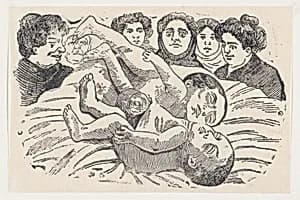
Siamese Twins
ca. 1880–1910
Medium
Zincograph
Dimensions
Sheet: 3 3/4 × 5 11/16 in. (9.5 × 14.4 cm)
Classification
Prints
Department
Drawings and Prints
Museum
Metropolitan Museum of Art, New York, NY
Credit
Gift of Jean Charlot, 1930
Accession Number
30.82.51
Rights
Public Domain
Tags
Art Historical Context
José Guadalupe Posada's *Siamese Twins*, created around 1880–1910, is a striking zincograph—a relief printing technique using zinc plates that allowed for affordable, high-volume production of images in Mexico. Measuring just 3 3/4 × 5 11/16 inches, this intimate print captures Posada's signature folk-art style: bold lines, dramatic contrasts, and a unflinching gaze at human curiosities. Housed in the Metropolitan Museum of Art's Drawings and Prints department, reflects the artist's mastery of popular printmaking for broadsheets and newspapers. Posada, a pivotal figure in Mexican graphic arts, bridged 19th-century illustration with the revolutionary era's visual culture. His works often depicted current events, social satire, and the macabre, influencing later artists like Diego Rivera. This piece, tagged with motifs of infants and women, likely sensationalizes conjoined twins—a common subject in period media that blurred spectacle and sympathy, highlighting societal fascination with the extraordinary amid Mexico's turbulent Porfiriato years. A gift from artist Jean Charlot in 1930, *Siamese Twins* exemplifies Posada's democratic art: accessible, urgent, and culturally resonant. Visitors will appreciate how it distills profound human stories into deceptively simple forms, inviting reflection on identity and otherness.
About the Artist
José Guadalupe Posada · 1852–1913
José Guadalupe Posada (1852-1913) was a Mexican printmaker and engraver who revolutionized popular art and created some of the most iconic images in Mexican culture. Working primarily with publisher Antonio Vanegas Arroyo, he produced over 20,000 images during his career—inexpensive broadsheets sold for a penny on colored paper that made his art accessible to even the poorest workers. He transform...