
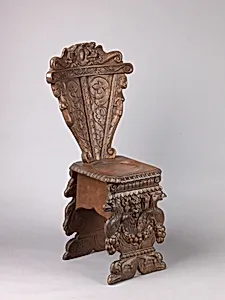
Side chair (sgabello a dorsale)
late 19th century
Medium
Walnut.
Dimensions
H. 98.6 cm, W. 49 cm, D. 39 cm
Classification
Woodwork-Furniture
Culture
Italian, Bolzano or Milan
Department
Robert Lehman Collection
Museum
Metropolitan Museum of Art, New York, NY
Credit
Robert Lehman Collection, 1975
Accession Number
1975.1.1992
Rights
Public Domain
Tags
Art Historical Context
This elegant walnut side chair, known as a *sgabello a dorsale*, was crafted in late 19th-century Italy, likely in Bolzano or Milan. The form revives a Renaissance favorite, with its tall, sculpted backrest rising from a sturdy rectangular seat supported by splayed legs. Walnut, prized for its rich grain and ability to take fine detail, was the favored material for such furniture, allowing carvers to create lively surface decoration without additional paint or gilding. The chair’s back is enlivened with carved birds, theatrical masks, and flowing garlands—motifs that echo classical and Renaissance ornament while reflecting the historicist tastes of the period. These elements transform a functional seating piece into a small work of sculpture, blending utility with visual delight. Makers such as Alois Überacher and the Fratelli Mora workshop carried forward traditional Italian woodworking skills at a time when machine production was beginning to dominate furniture manufacture. Acquired by the Metropolitan Museum as part of the Robert Lehman Collection, the chair offers visitors a window into Italy’s enduring love of carved wood and the 19th-century revival of historic forms. Its compact size and balanced proportions make it both comfortable and ornamental, a reminder that everyday objects can carry centuries of artistic tradition.
About the Artist
Alois Überacher|Fratelli Mora ( | ) · | – |
|