
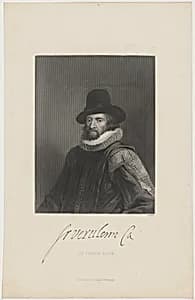
Sir Francis Bacon
1751 to 1775
Medium
engraving
Dimensions
sheet: 24.6 × 15.7 cm (9 11/16 × 6 3/16 in.)
Classification
Department
CG-E
Museum
National Gallery of Art, Washington, D.C.
Credit
Rosenwald Collection
Accession Number
1950.14.125
Rights
Public Domain
Art Historical Context
This elegant engraving, titled *Sir Francis Bacon*, captures the likeness of the renowned 17th-century English philosopher, statesman, and scientist—often hailed as the father of empiricism and modern scientific method. Created 1751 and 5 by engraver William I or II, it reflects the Enlightenment-era fascination with intellectual giants like Bacon (156–1626), whose such as *Novum Organum* championed observation and experimentation over blind tradition. Produced over two centuries after Bacon's death, the print served to immortalize his legacy in an age of growing scientific inquiry and portrait collecting. Engraving, the medium here, was a prized 18th-century technique involving incised metal plates inked and pressed onto paper, allowing for intricate details in facial features, ruffled collars, and textured fabrics within its modest 24.6 × 15.7 cm sheet. Holl's precise line work exemplifies the skill of British printmakers, who made affordable reproductions of famous portraits accessible to a wider audience beyond oil paintings. Housed in the National Gallery of Art's Rosenwald Collection—a treasure trove of prints—this piece highlights the cultural role of engravings in disseminating knowledge and prestige, bridging historical reverence with artistic innovation. Visitors will appreciate its crisp clarity, a testament to enduring printmaking mastery.