
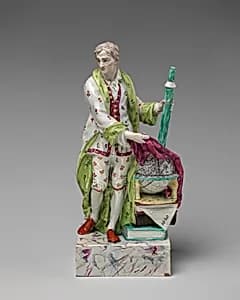
Sir Isaac Newton (1642–1727) (one of a pair)
ca. 1790
Medium
Lead-glazed earthenware
Dimensions
Height: 11 3/4 in. (29.8 cm)
Classification
Ceramics-Pottery
Culture
British, Burslem, Staffordshire
Department
European Sculpture and Decorative Arts
Museum
Metropolitan Museum of Art, New York, NY
Credit
Gift of R. Thornton Wilson, in memory of Florence Ellsworth Wilson, 1943
Accession Number
43.100.19
Rights
Public Domain
Tags
Art Historical Context
This charming lead-glazed earthenware figure of Sir Isaac Newton, created around 1790 by Ralph Wood the Younger in Burslem, Staffordshire, captures the renowned scientist in a dignified standing pose. Produced by one of the most celebrated families of English potters, the sculpture reflects the late eighteenth-century fascination with Enlightenment thinkers. Newton, celebrated for his groundbreaking work in physics and mathematics, was a popular subject for decorative arts at a time when scientific achievement was increasingly honored alongside political or literary heroes. Staffordshire potters like the Woods specialized in affordable yet expressive figures that brought grand portraiture into middle-class homes. Made from molded earthenware and finished with colorful lead glazes, these pieces were both durable and visually appealing. The figure’s modest scale—just under twelve inches tall—suggests it was designed for display on a mantel or shelf, often as one half of a pair that might have featured another intellectual luminary. Today in the Metropolitan Museum’s collection, this Newton serves as a delightful reminder of how scientific heroes entered everyday British life through the lively tradition of Staffordshire pottery.
About the Artist
Ralph Wood the Younger · 1748–1795
Ralph Wood the Younger was born in Burslem, Staffordshire, in 1748, the son of the celebrated potter Ralph Wood the Elder and a member of a family that stood at the center of the Staffordshire ceramics industry during its most creative and internationally influential period. Growing up in the workshops of his father, he absorbed from childhood the technical traditions of English earthenware produc...