
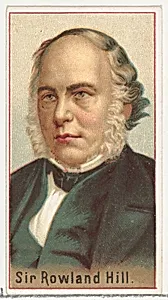
Sir Rowland Hill, printer's sample for the World's Inventors souvenir album (A25) for Allen & Ginter Cigarettes
1888
Medium
Commercial color lithograph
Dimensions
Sheet: 2 3/4 x 1 1/2 in. (7 x 3.8 cm)
Classification
Prints|Ephemera
Department
Drawings and Prints
Museum
Metropolitan Museum of Art, New York, NY
Credit
The Jefferson R. Burdick Collection, Gift of Jefferson R. Burdick
Accession Number
63.350.202.25.22
Rights
Public Domain
Tags
Art Historical Context
This commercial color lithograph from 1888 served as a printer’s sample for Allen & Ginter’s “World’s Inventors” souvenir album, a series of collectible cards distributed with cigarettes. Measuring just 2 ¾ by 1 ½ inches, the tiny portrait of Sir Rowland Hill was designed for easy insertion into an album, reflecting the era’s popular marketing strategy that turned everyday purchases into educational keepsakes. The tags identifying the subject as a teacher and inventor underscore the company’s aim to celebrate notable figures while encouraging brand loyalty. Color lithography allowed for vibrant, affordable reproduction at scale, making such ephemera widely accessible to the public. As a product of the Drawings and Prints department at the Metropolitan Museum of Art, this piece highlights how commercial printing techniques of the late nineteenth century blurred the line between advertising and art. Its presence in the Jefferson R. Burdick Collection preserves a fascinating glimpse into Victorian-era consumer culture and the inventive ways companies educated—and entertained—their customers.
About the Artist
Allen & Ginter
Allen & Ginter, the pioneering American tobacco firm based in Richmond, Virginia, emerged around 1880 from the partnership of John F. Allen and Lewis Ginter, evolving from Allen's earlier John F. Allen & Company. Allen retired in 1882, succeeded by John Pope, yet the brand endured under Ginter's leadership, employing over 1,100 workers—mostly women—for hand-rolled cigarettes by 1886. Ginter, a Dut...