
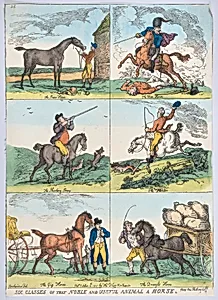
Six Classes of the Noble and Useful Animal a Horse
October 10, 1811
Medium
Hand-colored etching
Dimensions
Sheet: 13 7/8 × 9 5/8 in. (35.2 × 24.4 cm)
Classification
Prints
Department
Drawings and Prints
Museum
Metropolitan Museum of Art, New York, NY
Credit
The Elisha Whittelsey Collection, The Elisha Whittelsey Fund, 1959
Accession Number
59.533.1945
Rights
Public Domain
Tags
Art Historical Context
Created in 1811 by the renowned English caricaturist Thomas Rowland and published by Thomas Tegg,Six Classes of the Noble Useful Animal a Horse* a hand-colored etching that captures the satirical spirit of Regency-era Britain. Measuring 13⅞ × 9⅝ inches, this print from the Metropolitan Museum of Art Elisha Whittelsey Collection exemplifies Rowlandson's mastery of exaggerated humor, poking fun at society's obsession with horses through six distinct "classes"—likely from noble racers to humble workhorses, intertwined with men and hunting scenes. Rowlandson, a key figure in the caricature boom of the late 18th and early 19th centuries, used etching—a precise intaglio technique—for sharp lines and dynamic compositions, then hand-applied vibrant colors to heighten the comedic effect. This medium was ideal for affordable, widely circulated satires sold in London's print shops, critiquing class distinctions and equestrian culture amid the era's horse racing mania and aristocratic hunts. The artwork's cultural bite lies in its ironic title, elevating horses as "noble and useful" while lampooning human folly. It reflects how prints like this democratized wit, entertaining middle-class audiences with Rowlandson's bawdy, observational style that influenced later cartoonists. A delightful window into Georgian social commentary!
About the Artist
Thomas Rowlandson|Thomas Tegg · 1756–1827
Thomas Rowlandson (1757–1827) was an English artist and caricaturist whose satirical watercolors and prints captured the social life of Georgian Britain with unparalleled wit and technical mastery. Alongside James Gillray, he is recognized as one of the greatest British graphic artists, and his distinctive flowing line and keen observations have made his work integral to understanding late 18th an...