
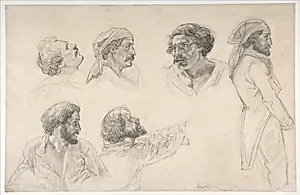
Six studies for Corréard and Savigny in the "Raft of the Medusa"
before 1818
Medium
Black chalk
Dimensions
10 1/16 x 15 9/16 in. (25.6 x 39.6 cm)
Classification
Drawings
Department
Drawings and Prints
Museum
Metropolitan Museum of Art, New York, NY
Credit
Bequest of Walter C. Baker, 1971
Accession Number
1972.118.216
Rights
Public Domain
Tags
Art Historical Context
Théodore Géricault *Six Studies for Corréard andigny in the "R of the Medusa"* a fascinating glimpse into the artist's preparatory process for one of art history's most iconic works. Created before 1818 in black chalk, these intimate drawings (10 1/16 x 15 9/16 in.) profile portraits of two key survivors—Pierre-Alexandre Corréard Alexandre Savigny—from the tragic 1816 shipwreck of the French frigateMéduse*. Géricault, a leading figure in Romanticism, obsessively studied real-life models to infuse his monumental painting with raw human emotion and realism. The *Raft of the Medusa* scandalized France by exposing governmental incompetence: 147 passengers adrift on a makeshift raft led to just 15 survivors after cannibalism and despair. These studies highlight Géricault's innovative technique—modeling heads from life in various poses to convey desperation and resilience—elevating drawing from mere sketch to a vital tool for historical truth-telling. Housed in the Metropolitan Museum of Art's Drawings and Prints department (Bequest of Walter C. Baker, 1971), these works exemplify Romanticism's shift toward dramatic, socially charged narratives, bridging classical portraiture with modern intensity. Visitors will appreciate how Géricault's chalk lines breathe life into profiles that fueled a masterpiece of human suffering and survival.
About the Artist
Théodore Gericault · 1791–1824
Théodore Géricault, born Jean-Louis André Théodore Géricault on September 26, 1791, in Rouen, France, into a prosperous family—his father a lawyer turned tobacco merchant and his mother from a line of growers—moved to Paris around 1797. Displaying early artistic promise, recognized by painter Jean-Louis Laneuville, he began formal training in 1808 under Carle Vernet, mastering English sporting art...