
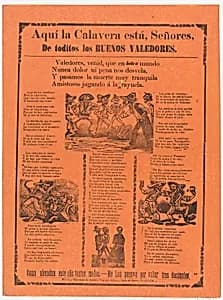
Skeletons of the good defenders
Medium
Type-metal engraving and letterpress on orange paper
Dimensions
Sheet: 15 3/4 × 11 13/16 in. (40 × 30 cm)
Classification
Prints
Department
Drawings and Prints
Museum
Metropolitan Museum of Art, New York, NY
Credit
The Elisha Whittelsey Collection, The Elisha Whittelsey Fund, 1946
Accession Number
46.46.310
Rights
Public Domain
Tags
Art Historical Context
Behold *Skeletons the Good Defenders*, a striking print from around 1900–1910, created a collaboration between celebrated Mexican artist José Guadalupe Pos, engraver Manuel Manilla, publisher Antonio Vanegas Arroyo This type-metal engraving and letterpress vibrant orange paper measures about 15¾ × 11⅞ inches and depicts dancing skeletons—a hallmark of Posada's iconiccalavera* style. lively skeletal figures, frozen macabre revelry, evoke the Mexican tradition of mocking death with humor and irreverence. Posada, master of popular broadsides, produced thousands of such satirical works during Mexico's turbulent Porfirio Díaz era, often critiquing politicians, the wealthy, and societal hypocrisies. The title slyly nods to "good defenders," likely poking fun at corrupt officials or soldiers who fancied themselves protectors of the people. Rendered in bold black lines against the fiery orange ground, the print's high-contrast relief printing technique made it affordable and widely accessible via street vendors, amplifying its cultural bite. Housed in the Metropolitan Museum of Art's Drawings and Prints department, this piece exemplifies Posada's enduring influence on Mexican graphic art and Day of the Dead imagery. It reminds us that in the face of mortality, satire levels all—skeletons dance without distinction of rank. (198 words)
About the Artist
José Guadalupe Posada|Antonio Vanegas Arroyo|Manuel Manilla · 1852–1913
José Guadalupe Posada (1852-1913) was a Mexican printmaker and engraver who revolutionized popular art and created some of the most iconic images in Mexican culture. Working primarily with publisher Antonio Vanegas Arroyo, he produced over 20,000 images during his career—inexpensive broadsheets sold for a penny on colored paper that made his art accessible to even the poorest workers. He transform...