
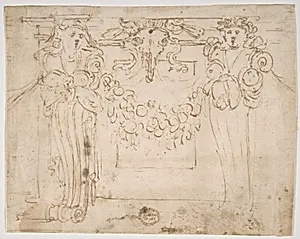
Sketch for a wall panel in the Sala Paolina at Castel Sant' Angelo, Rome
Medium
Pen and brown ink
Dimensions
5 × 6 3/8 in. (12.7 × 16.2 cm)
Classification
Drawings
Department
Drawings and Prints
Museum
Metropolitan Museum of Art, New York, NY
Credit
Gift of Cornelius Vanderbilt, 1880
Accession Number
80.3.642
Rights
Public Domain
Tags
Art Historical Context
This delicate pen and brown ink sketch by Perino del VagaPietro Buonaccorsi dated around 1546, served as a preparatory design for a wall panel in's Sala Paolina at Castel Sant'Angelo, the fortress-turned-papal residence. Perino, a leading Mannerist artist and Raphael pupil, contributed to this grand decorative project under Pope Paul III, blending classical grace with elegant, elongated figures—likely the women suggested by the tags. At just 5 × 6 3/8 inches, it captures the intricate planning behind the hall's frescoes, which celebrated papal power amid the Counter-Reformation era. Mannerism's hallmark fluidity shines in Perino's precise brown ink lines, allowing for dynamic poses and rhythmic compositions that would translate to vibrant wall paintings. This technique, common in 16th-century Italian workshops, enabled artists to refine ideas quickly before scaling up. The sketch's survival offers a rare glimpse into Renaissance design processes, where drawings bridged imagination and monumental architecture. A gift to the Metropolitan Museum of Art from Cornelius Vanderbilt in 1880, this work highlights Perino's role in Rome's artistic golden age, bridging Raphael's harmony and Michelangelo's dynamism. Visitors can appreciate how such modest studies fueled the opulent splendor of papal spaces.
About the Artist
Perino del Vaga (Pietro Buonaccorsi) · 1501–1547
Perino del Vaga, born Piero Bonaccorsi in 1501 near Florence, emerged as one of the most elegant painters of the Mannerist era. Orphaned early—his mother died when he was two months old and his father, a gambler turned soldier, left him in the care of a stepmother—Perino received an unconventional start, apprenticed first to a druggist and then to the mediocre Andrea de' Ceri. At age eleven, he en...