
Sketch of a Statue: Guardian Angel
ca. 1850
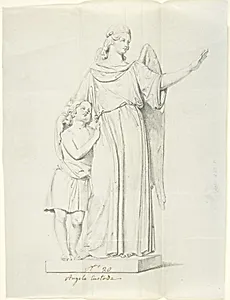
Medium
Graphite, with inscriptions in pen and brown ink
Dimensions
sheet: 7 3/16 x 5 3/8 in. (18.2 x 13.7 cm)
Classification
Drawings
Department
Drawings and Prints
Museum
Metropolitan Museum of Art, New York, NY
Credit
Gift of Mrs. John De Witt Peltz, 1977
Accession Number
1977.382.6
Rights
Public Domain
Tags
Art Historical Context
John Gibson's *Sketch of a Statue: Angel* (ca. 1850) captures the neoclassical sculptor's vision for a tender, protective figure, likely evoking the Victorian fascination with guardian spirits watching over children. Rendered on a modest sheet of paper measuring 7 3/16 x 5 3/8 inches, this preparatory drawing hints at Gibson's monumental marble works, for which he was renowned in Rome's international artist community. Trained under eminent sculptors like Bertel Thorvaldsen, Gibson blended classical ideals of grace and proportion with romantic sentiment, making angelic themes a poignant reflection of 19th-century spiritual and familial ideals. The artwork's graphite medium allows for delicate shading and fluid lines that model the statue's form, while inscriptions in pen and brown ink—possibly notations on pose or anatomy—reveal Gibson's meticulous planning process. As a neoclassicist, he prized such sketches for refining compositions before carving, bridging the gap between two-dimensional idea and three-dimensional reality. Housed in the Metropolitan Museum of Art's Drawings and Prints department, this piece (gift of Mrs. John De Witt Peltz, 1977) offers visitors a rare glimpse into the artist's studio practice. Its tags—angels and children—underscore enduring cultural motifs of divine protection, resonating today as a symbol of innocence safeguarded amid industrial-era uncertainties.
About the Artist
John Gibson · 1790–1866
Outstanding Neoclassical sculptor who experimented with the ancient practice of coloring statues, e.g. his 'Tinted Venus' (1851). Flaxman encourgaged him to go to Rome, where he spent most of his life. He left his fortune to the National Gallery, London. British sculptor, active Rome. Comment on works: sculptor