
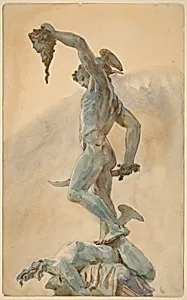
Sketch of Cellini's "Perseus"
c. 1909/1910
Medium
watercolor over graphite on wove paper
Dimensions
sheet: 36.5 × 22.7 cm (14 3/8 × 8 15/16 in.)
Classification
Drawing
Department
CG-W
Museum
National Gallery of Art, Washington, D.C.
Credit
Gift of R. Horace Gallatin
Accession Number
1949.1.57
Rights
Public Domain
Art Historical Context
John Singer Sargent’s “Sketch of Cellini’s ‘Perseus’” captures the dramatic bronze masterpiece created by the Renaissance sculptor Benvenuto Cellini in 1545–1554. Standing in Florence’s Piazza della Signoria, Cellini’s heroic figure of Perseus triumphantly holds the head of Medusa aloft, a symbol of courage and artistic virtuosity that has inspired generations. Sargent, working around 1909–1910 during his travels in Italy, translated this monumental sculpture into a more intimate study on paper. Executed in watercolor over graphite on wove paper, the drawing reveals Sargent’s keen eye for light, shadow, and form. The translucent washes allow the underlying graphite lines to define the sculpture’s powerful anatomy and dynamic pose, while subtle color accents suggest the patina of the bronze. As an American expatriate artist celebrated for both his society portraits and vibrant watercolors, Sargent often turned to Old Master works for inspiration, using such sketches to explore classical ideals of beauty and movement. This delicate sheet, now in the collection of the National Gallery of Art thanks to a generous gift from R. Horace Gallatin, offers visitors a window into the dialogue between Renaissance sculpture and early twentieth-century draftsmanship. It reminds us how artists continue to learn from and reinterpret the past, keeping timeless works alive through fresh observation.