
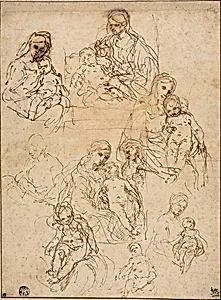
Sketches of the Virgin and Child, and the Holy Family
1642/48
Medium
Pen and brown ink on buff laid paper, laid down on cream board
Dimensions
27.2 × 20.2 cm (10 3/4 × 8 in.)
Classification
pen and ink drawings
Department
Prints and Drawings
Museum
Art Institute of Chicago
Accession Number
81007
Rights
Public Domain
About this artwork
A pupil of Guido Reni and a gifted draftsman,Cantarini has used a sensitive line to capture eight variations on the Madonna and Child with magic and spontaneity. This drawing once belonged to the French collector Pierre Jean Mariette, whose stamp appears at the lower left in black.
Art Historical Context
Simone Cantarini, an Italian Baroque artist known as "il Pesarese," created these delicate *Sketches of the Virgin and Child, and the Holy Family* between 1642 and 1648. Working primarily in Bologna and Rome, Cantarini drew inspiration from masters like Guido Reni, blending classical elegance with emotional depth characteristic of the Baroque era. This pen and brown ink drawing on buff laid paper, now laid down on cream board, measures a modest 27.2 × 20.2 cm and resides in the Art Institute of Chicago's Prints and Drawings collection. These sketches exemplify Cantarini's preparatory process, where rapid, fluid lines capture tender moments of maternal devotion—a staple of Christian iconography. The brown ink allows for expressive hatching and cross-hatching, building subtle volume and light on figures that evoke serenity and divinity. Such works were vital in the 17th century for artists refining compositions before painting or etching, showcasing Cantarini's skill in translating devotion into dynamic form. Though Cantarini died young at 36, his drawings highlight the Baroque fascination with movement and spirituality, offering visitors a glimpse into the intimate creative world behind grand altarpieces. A true treasure for admirers of Italian draftsmanship!
About the Artist
Simone Cantarini · 1612–1648
He was one of the most eminent pupils of Guido Reni and one of the most gifted engravers in the tradition of the Carracci. He had a strong personality and developed a highly original style, which united aspects of Bolognese classicism with a bold naturalism. Comment on works: Religious