
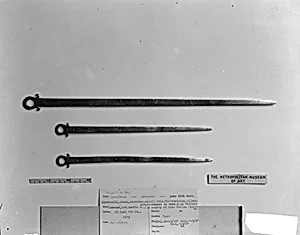
Skewer
1775–1800
Medium
Silver
Dimensions
L. 7 7/8 in. (20 cm)
Classification
Skewer
Culture
American
Department
The American Wing
Museum
Metropolitan Museum of Art, New York, NY
Credit
Gift of Mrs. Amelia B. Lazarus, in memory of Miss Emilie Lazarus, 1895
Accession Number
95.1.18
Rights
Public Domain
Art Historical Context
This elegant silver skewer, crafted by American silversmith John Letelier Sr. between 1775 and 1800, exemplifies the refined craftsmanship of the late colonial and early Federal periods. Measuring just under eight inches, the piece was likely used for roasting or serving meats at the table, transforming a utilitarian kitchen tool into an object of understated luxury. Letelier, working in the American Wing’s collection at The Metropolitan Museum of Art, belonged to a generation of artisans who blended European traditions with emerging American tastes. Silver held particular significance in early America as both a practical metal and a marker of status. Its durability and luster made it ideal for items that would see frequent use, while its value allowed families to display wealth discreetly. Created during the Revolutionary era and the young nation’s first decades, this skewer reflects a time when household goods increasingly expressed both function and quiet elegance. Donated to the museum in 1895 by Mrs. Amelia B. Lazarus, the skewer preserves a tangible link to 18th-century domestic life. Its presence in the collection highlights how even the smallest silver objects reveal broader stories of craftsmanship, trade, and social aspiration in early America.