
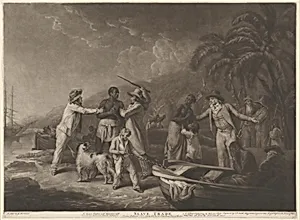
Slave Trade
Medium
mezzotint on laid paper
Dimensions
plate: 48.2 x 66.5 cm (19 x 26 3/16 in.) sheet: 48.5 x 66.5 cm (19 1/8 x 26 3/16 in.)
Classification
Department
CG-E
Museum
National Gallery of Art, Washington, D.C.
Credit
Paul Mellon Fund
Accession Number
2001.118.62
Rights
Public Domain
Art Historical Context
1791, as British abolitionists pressed Parliament to ban the slave trade, George Morland designed this scene and John Raphael Smith translated it into mezzotint so that viewers far from the coast could witness what the traffic in people actually looked like. The print shows armed Europeans seizing Africans on a West African shore, binding them for transport to a waiting ship whose masts rise on the left horizon. Rather than a panoramic view from the safety of the water, the composition places the action on the sand itself, so the struggle fills the foreground. The raised club, the taut chain linking wrists to ankles, and the small child clinging to an adult all sit at eye level, turning the transaction into a physical contest rather than an abstract commerce. The National Gallery of Art holds the print in its collection of works on paper. Look at the lowered head of the seated man in the right foreground; his stillness amid the surrounding motion quietly registers the moment after resistance has been broken.