
Slide Guard
Unknown Artist
dated 1650
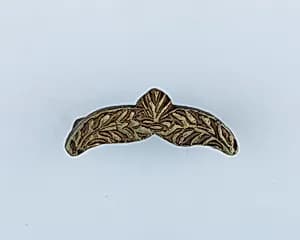
Medium
Brass
Dimensions
H. 1 3/8 in. (3.5 cm); W. 5/8 in. (1.6 cm); thickness 1/2 in. (1.3 cm); Wt. 0.2 oz. (7 g)
Classification
Miscellaneous-Buckles & Ornament
Culture
Italian
Department
Arms and Armor
Museum
Metropolitan Museum of Art, New York, NY
Credit
Gift of Bashford Dean, 1920
Accession Number
20.152.215
Rights
Public Domain
Art Historical Context
Nestled in the Metropolitan Museum of Art's Arms and Armor Department, this petite *Slide Guard* from 1650 exemplifies the exquisite metalwork of 17th-century Italy. Crafted from brass—a durable yet malleable alloy ideal for intricate fittings—this tiny ornament measures just 1 3/8 inches high and weighs a mere 0.2 ounces. Its classification as a buckle and ornament suggests it served as a functional slide for securing straps on armor, belts, or harnesses, blending utility with subtle elegance during the Baroque era's height of military pageantry. In Renaissance and early Baroque Italy, armorers in cities like Milan and Venice were renowned for such precision components, which protected wearers while showcasing technical prowess. The slide guard's compact form highlights advanced brass-casting and finishing techniques, allowing for smooth operation and resistance to wear amid the rigors of battle or tournament. Though by an unknown artist, it reflects the anonymous mastery of Italian workshops, where even the smallest pieces contributed to the grandeur of full ensembles. Gifted to the Met in 1920 by collector Bashford Dean, this artifact invites us to appreciate the unsung details of historical defense—reminders that armor was as much art as protection.