
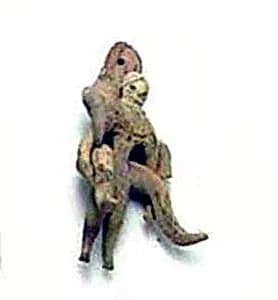
Small Male Figure Supporting Larger Fertility Goddess on His Back
Unknown Artist
ca. 3000–2500 BCE
Medium
Terracotta
Dimensions
H. 4 3/4 in. (12.1 cm); W. 2 1/4 in. (5.7 cm)
Classification
Ceramics
Culture & Period
Pakistan (Baluchistan) · Indus civilization
Department
Asian Art
Museum
Metropolitan Museum of Art, New York, NY
Credit
Gift of Jeannette and Jonathan Rosen, 2001
Accession Number
2001.794.215
Rights
Public Domain
Tags
Art Historical Context
This small terracotta sculpture, created around 3000–2500 BCE in the Baluchistan region of present-day Pakistan, captures a compelling scene from the Indus civilization. A diminutive male figure bears a larger female form—interpreted as a fertility goddess—upon his back. Standing just under five inches tall, the piece exemplifies the intimate scale of many Indus artifacts, likely designed for personal or household ritual use rather than public display. Terracotta was a favored medium across the Indus Valley for its accessibility and versatility, allowing artisans to model expressive figures by hand before firing. Such representations of mother goddesses or fertility deities appear frequently in the archaeological record, underscoring the civilization’s reverence for abundance, reproduction, and the natural world. The unusual composition, with the male supporting the goddess, may hint at mythological narratives or social roles that remain subjects of scholarly interest. Housed in the Metropolitan Museum’s Asian Art collection, this work offers a rare glimpse into one of the world’s earliest urban societies. Its survival across five millennia speaks to both the durability of fired clay and the enduring human fascination with themes of support, strength, and the sacred feminine.