
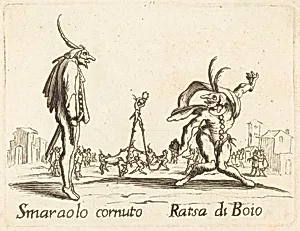
Smaralo Cornuto and Ratsa di Boio
1622 or later
Medium
etching on laid paper
Dimensions
plate: 6.9 × 9 cm (2 11/16 × 3 9/16 in.) sheet: 7.7 × 10.2 cm (3 1/16 × 4 in.)
Classification
Department
CG-E
Museum
National Gallery of Art, Washington, D.C.
Credit
Rosenwald Collection
Accession Number
1943.3.2191
Rights
Public Domain
Art Historical Context
Discover the whimsical yet grotesque world of *Smaralo Cornuto and Ratsa di Boio*, an etching after the masterful French printmaker Jacques Callot, created in 1622 or later. Callot, a Baroque innovator who bridged Mannerism and the emerging Rococo, was renowned for his intricate small-scale prints capturing the exuberant chaos of Italian commedia dell'arte. This diminutive plate (just 6.9 × 9 cm) likely draws from his celebrated *Balli di Sfessania* series, featuring fantastical dancers with exaggerated, satirical features—Smaralo Cornuto ("Scaramouche the Cuckold") and Ratsa di Boio evoking the masked buffoons and lovers of 17th-century theater. Etched on laid paper, the work showcases Callot's pioneering *échiure* technique, using multiple acid bites and a hard-ground varnish on copper plates to achieve astonishing fine lines and textures in such a tiny format. This allowed mass production of affordable, portable art that brought lively street performances into homes across Europe, influencing later caricature and genre scenes. Housed in the National Gallery of Art's Rosenwald Collection (Department CG-E), this print exemplifies Callot's cultural snapshot of festive excess amid Europe's turbulent early 17th century. Up close, its intricate details reveal a masterful blend of humor and horror—perfect for pondering the timeless appeal of human folly.
About the Artist
after Jacques Callot
**Jacques Callot (c. 1592–1635)**, the master whose designs inspired the works attributed "after Jacques Callot," was a pioneering French Baroque printmaker and draftsman born in Nancy, capital of the independent Duchy of Lorraine (now northeastern France). From a noble family—his father served as master of ceremonies and herald-at-arms to the Duke of Lorraine—young Callot was apprenticed to a gol...