
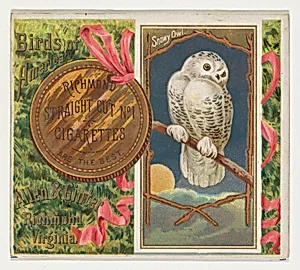
Snowy Owl, from the Birds of America series (N37) for Allen & Ginter Cigarettes
1888
Medium
Commercial color lithograph
Dimensions
Sheet: 2 7/8 x 3 1/4 in. (7.3 x 8.3 cm)
Classification
Prints|Ephemera
Department
Drawings and Prints
Museum
Metropolitan Museum of Art, New York, NY
Credit
The Jefferson R. Burdick Collection, Gift of Jefferson R. Burdick
Accession Number
63.350.202.37.39
Rights
Public Domain
Tags
Art Historical Context
Behold the majestic *Snowy Owl* from the *Birds of America* seriesN37), a delightful chromolithograph produced by the pioneering tobacco company Allen & Ginter in1888. These tiny treasures—measuring just 2 7/8 x 3 1/4 inches—were inserted into cigarette packs as collectible trading cards, sparking a craze among enthusiasts in late 19th-century America Allen & Ginter, innovators in the industry, used such series to educate and entertain smokers while boosting brand loyalty, blending commerce with natural history. Crafted as a commercial color lithograph, this print showcases the era's breakthrough in chromolithography, a technique layering vibrant hues through multiple stone plates for stunning, realistic detail at low cost. The Snowy Owl, with its piercing yellow eyes and pristine white plumage, captures the bird's Arctic mystique, evoking vast snowy expanses. Far from fine art, these ephemera democratized ornithological imagery, inspiring budding naturalists. Today, this card graces the Metropolitan Museum of Art's Drawings and Prints department, part of the Jefferson R. Burdick Collection—a gift that elevates everyday objects to cultural icons. It reminds us how advertising once fueled fascination with the natural world. (198 words)
About the Artist
Allen & Ginter
Allen & Ginter, the pioneering American tobacco firm based in Richmond, Virginia, emerged around 1880 from the partnership of John F. Allen and Lewis Ginter, evolving from Allen's earlier John F. Allen & Company. Allen retired in 1882, succeeded by John Pope, yet the brand endured under Ginter's leadership, employing over 1,100 workers—mostly women—for hand-rolled cigarettes by 1886. Ginter, a Dut...