
BK-17159
c. 1815 - c. 1830
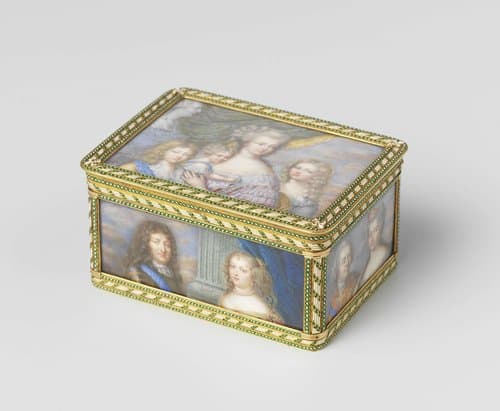
Medium
painting technique
Dimensions
8.8; 4.5; 4.5; 259.6
Rights
Public Domain
About this artwork
…; purchased by Empress Alexandra Feodorovna (1798-1860);{Baarsen 2013, p. 488, no. 119.} by whom donated to Prince Pyotr Mikhailovich Wolkonsky (1776-1852);{Baarsen 2013, p. 488, no. 119.} by whom bequeathed to the imperial collection in the Hermitage, 1852;{Baarsen 2013, p. 488, no. 119.} collection Hermitage, Petersburg, 1902;{Les Trésors d’art en Russie 1902, no. 144.}…; collection Dr Fritz Mannheimer (1890-1939), Amsterdam and Paris, 1936;{Von Falke 1936, p. 76, no. K.162.} purchased from h...
Art Historical Context
This diminutive anonymous artwork, titled *BK-17159* and dated around 1815–1830, exemplifies exquisite "painting technique" favored for small-scale decorative objects of the early 19th century. just 4.5 cm high by 8.8 cm wide (with a depth of4.5 cm and weight of 259.6 g), it likely served as a luxurious personal item, such as a snuffbox or étui, showcasing the finesse of miniature painting on a portable scale. Such works were prized for their intricate detail portability, reflecting the neoclassical tastes of Europe's elite during the Napoleonic aftermath. Its provenance reads like a chapter from European history. Acquired by Empress Alexandra Feodorovna (1798–1860), wife of Tsar Nicholas I, it passed to Prince Pyotr Mikhailovich Wolkonsky before entering the Hermitage's imperial collection in 1852. It later graced the collections of Dr. Fritz Mannheimer and, tragically, was seized in 1940 for Adolf Hitler's planned Führermuseum in Linz via the Dienststelle Mühlmann. Recuperated after World War II by the Soviet NKO (SNK) in 1945, it was loaned and eventually transferred to its current museum home by 1960. This object's journey—from Russian Romanov splendor to wartime plunder and recovery—highlights the resilience of cultural treasures amid geopolitical upheaval, underscoring their enduring value as windows into bygone eras.
About the Artist
anonymous
In the vast tapestry of art history, "Anonymous" stands not as a singular individual but as a collective designation for countless unidentified creators whose works have endured across millennia. These artists, spanning prehistoric cave painters to medieval illuminators and folk craftsmen, produced the foundational layers of human visual culture. Prior to the Renaissance, when individual fame emer...