
Soeur Pierrette Toussaine Blondeau, Hospices de Beaune
1845–50
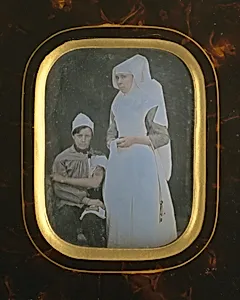
Medium
Daguerreotype with applied color
Dimensions
Visible: 12.8 x 9.4 cm (5 1/16 x 3 11/16 in.) Passe-partout: 21.5 x 17.2 cm (8 7/16 x 6 3/4 in.) Frame: 27.5 x 23.8 cm (10 13/16 x 9 3/8 in.)
Classification
Photographs
Department
Photographs
Museum
Metropolitan Museum of Art, New York, NY
Credit
Gilman Collection, Purchase, The Howard Gilman Foundation Gift, 2002
Accession Number
2002.275
Rights
Public Domain
Tags
Art Historical Context
Step into the luminous world of early photography with *Soeur Pierrette Toussaine Blonde, Hospices de Beaune*, daguerreotype from 184–50. This intimate portrait, captured by an unknown artist, the namesake sister—a nun from the renowned Hospices de Beaune, historic charity hospital in Burgundy, France founded in 1443 aid the poor and sick. Hand-tinted with applied color, the image brings a touch of realism to the era's cutting-edge medium, measuring a modest 12.8 x 9.4 cm within its ornate frame. Daguerreotypes, introduced just six years earlier by Louis Daguerre, were the first practical photographic process, producing one-of-a-kind, mirror-like positives on silvered copper plates renowned for their exquisite detail and tonal range. The subtle coloring enhances the portrait's emotional depth, highlighting fabrics, skin tones, and expressions in a way that bridged painting and photography. Tags noting women, boys, and portraits suggest a tender group composition, perhaps evoking the hospital's caregiving mission amid children. Housed in the Metropolitan Museum of Art's Gilman Collection, this piece underscores photography's rapid rise in the 1840s as a tool for personal and institutional commemoration. It offers a poignant glimpse into 19th-century French charitable life, where figures like Sister Pierrette embodied devotion, preserved forever in silver and light.
About the Artist
Unknown
The artist designated as "Unknown" in our virtual museum's collection exemplifies a poignant chapter in art history: creators whose identities have faded into obscurity despite the enduring power of their work. With only one known artwork attributed to them in our holdings, this figure represents countless anonymous hands that shaped visual culture across centuries. Museums worldwide, including th...