
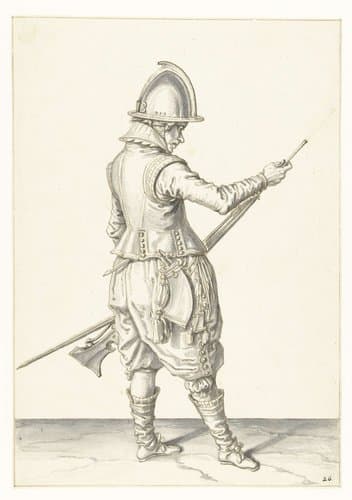
Soldaat die met zijn laadstok kruit en kogel in de loop van zijn roer duwt
1596 - 1606
Medium
pen
Dimensions
264; 183
Rights
Public Domain
About this artwork
Een soldaat, ten voeten uit, naar rechts, die met zijn linkerhand bij zijn linkerdijbeen een roer (een bepaald type vuurwapen) vasthoudt en met zijn rechterhand zijn laadstok in de loop brengt, om kruit en kogel aan te duwen (nr. 26), ca. 1600. Plaat 26 in de instructies voor het hanteren van de roer: Corte onderwysinghe op de figuerliicke afbeeldinghe, belanghende t'rechte ghebruyck des Roers. Onderdeel van de illustraties in: J. de Gheyn, Wapenhandelinghe van Roers Musquetten ende spiessen, 's...
Art Historical Context
This pen drawing by Jacques de Gheyn II captures a musketeer in the precise act of loading his weapon, using the ramrod to pack powder and ball into the barrel. Created between 1596 and 6 as plate 26 the artist’s influential manual *Whandelinghe van Roers, Musquetten ende Spiessen* (published in The Hague in 1607), the sheet served as a design for an instructional engraving. Standing full-length and facing right, the soldier demonstrates one of the many carefully sequenced steps required to handle the early firearm safely and effectively. De Gheyn’s work emerged during a period when European armies, particularly in the Dutch Republic, were developing standardized drill to improve battlefield discipline. His manual became one of the most widely copied military training books of the seventeenth century, illustrating 32 positions for the musket alone. The clear, measured lines of this preparatory drawing reflect the artist’s skill in conveying complex physical movements with clarity, ensuring soldiers could follow the instructions at a glance. Measuring 264 by 183 millimeters, the drawing exemplifies de Gheyn’s reputation for meticulous observation and instructional art. Though created as a practical tool rather than a finished work of art, it offers modern viewers a vivid glimpse into the daily realities of early modern warfare and the intersection of art and military science around 1600.