
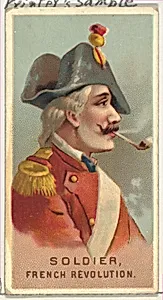
Soldier, French Revolution, from World's Smokers series (N33) for Allen & Ginter Cigarettes
1888
Medium
Commercial color lithograph
Dimensions
Sheet: 2 3/4 x 1 1/2 in. (7 x 3.8 cm)
Classification
Prints|Ephemera
Department
Drawings and Prints
Museum
Metropolitan Museum of Art, New York, NY
Credit
The Jefferson R. Burdick Collection, Gift of Jefferson R. Burdick
Accession Number
63.350.202.33.26
Rights
Public Domain
Tags
Art Historical Context
Step into the vibrant world of 19th-century advertising with *Soldier, French Revolution*, a gem from Allen & Ginter's *World's Smokers* series (N33), issued in 1888. These chromolithographs—colorful prints produced through a meticulous layering of lithographic stones—were tucked into cigarette packs as collectible incentives, transforming everyday tobacco products into portals of historical fantasy. Allen & Ginter, pioneering American tobacco innovators, used such cards to captivate smokers and non-smokers alike, blending commerce with escapism during the Gilded Age. This 2¾ x 1½-inch card profiles a stern French Revolutionary soldier, pipe in mouth, evoking the turbulent 1789–1799 era of liberty, equality, and guillotines. The precise, vivid lithography captures his tricorn hat, uniform, and determined gaze in striking detail, romanticizing a figure from history's dramatic upheavals. Such depictions tapped into Victorian fascination with the past, while subtly glorifying smoking as a manly pursuit. Today, preserved in The Metropolitan Museum of Art's Jefferson R. Burdick Collection, this ephemera highlights how commercial art democratized imagery, bridging high history with popular culture. A testament to lithography's technical triumph, it reminds us how even cigarette cards endure as cultural artifacts.
About the Artist
Allen & Ginter
Allen & Ginter, the pioneering American tobacco firm based in Richmond, Virginia, emerged around 1880 from the partnership of John F. Allen and Lewis Ginter, evolving from Allen's earlier John F. Allen & Company. Allen retired in 1882, succeeded by John Pope, yet the brand endured under Ginter's leadership, employing over 1,100 workers—mostly women—for hand-rolled cigarettes by 1886. Ginter, a Dut...