
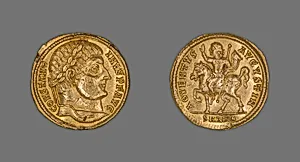
Solidus (Coin) Portraying Emperor Constantine I
Late 324-early 325, issued by Constantine I
Medium
Gold
Dimensions
Diam.: 1.9 cm (3/4 in.)
Classification
coin
Department
Arts of Greece, Rome, and Byzantium
Museum
Art Institute of Chicago
Accession Number
96052
Rights
Public Domain
About this artwork
The portrait of Constantine on the front (obverse) of this coin is among the last in the history of Roman coinage, for increasingly the emphasis lay not on the individual person of the emperor but on the office. Constantine's luminous eyes in this coin portrait were said by his contemporaries to reflect his divine inspiration. On the back (reverse) of the coin, Constantine rides to the left on horseback, raising his right arm, and carrying a scepter in his left.
Art Historical Context
This exquisite gold solidus, struck in late 324 to early 325 CE under Emperor Constantine I, captures the powerful visage of one of Rome's most transformative rulers. Measuring just 1.9 cm in diameter, this tiny masterpiece from the Art Institute of Chicago Arts of Greece, Rome and Byzantium department exemplifies precision of ancient Roman minting techniques. The emperor's portrait, likely idealized on the obverse to convey authority and divinity, was created using finely engraved dies that impressed intricate details onto pure gold blanks, ensuring both beauty and durability. Minted during a pivotal moment in Roman history, the coin commemorates Constantine's decisive victory over his rival Licinius in 324 CE, solidifying his sole rule over the empire. Constantine, who famously legalized Christianity via the Edict of Milan in 313 CE and later founded Constantinople, used such coinage as propaganda tools to broadcast his image and legitimacy across the vast realm. As the first major gold coin of its kind—the solidus—this piece revolutionized Roman economics, maintaining a stable weight and purity that influenced Byzantine and medieval currencies for centuries. Far more than money, it embodies the artistry and imperial ambition of late antiquity, inviting us to ponder the emperor's enduring legacy in a single gleaming disc.
About the Artist
Ancient Roman
The artists attributed to "Ancient Roman" in museum collections represent the anonymous craftsmen who produced the vast output of sculpture, frescoes, mosaics, and reliefs defining Roman visual culture from the Republic (c. 509–27 BCE) to the late Empire (c. 395 CE). Individual identities remain elusive, as Roman makers were typically viewed as skilled tradesmen—often enslaved Greeks or provincial...