
Solving a Puzzle
Early to mid-18th century
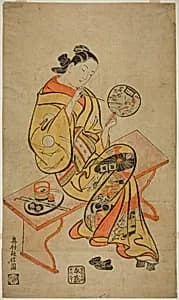
Medium
Woodblock print; hand-colored sumie-e
Dimensions
56.3 × 33.1 cm (22 3/16 × 13 1/16 in.)
Classification
woodblock print
Department
Arts of Asia
Museum
Art Institute of Chicago
Accession Number
21405
Rights
Public Domain
Art Historical Context
**Solving a Puzzle** by Okumura Masanobu captures a delightful moment of everyday amusement in 18th-century Japan. Created during the early to mid-Edo period (roughly 1700s), this woodblock print reflects the ukiyo-e tradition—"pictures of the floating world"—which celebrated fleeting pleasures like games and leisure. Masanobu (1686–1764), a pioneering printmaker, often depicted urban life in Edo (modern Tokyo), blending humor with keen observation of human interaction. Here, figures huddled over a puzzle evoke the social joys of the merchant class, a rising force in Japan's vibrant cultural scene. The artwork's medium—a hand-colored *sumi-e* woodblock print—highlights Masanobu's technical innovation. *Sumi-e*, or ink wash painting, traditionally uses subtle monochrome tones for expressive brushwork, but Masanobu's hand-coloring adds vibrant hues, bridging single-color prints (*benizuri-e*) toward multicolored masterpieces. Measuring 56.3 × 33.1 cm, its intimate scale suited affordable urban homes or shops, making art accessible beyond elites. This technique influenced later ukiyo-e giants like Hiroshige and Hokusai. Housed in the Art Institute of Chicago's Arts of Asia department, *Solving a Puzzle* offers a window into Japan's playful ingenuity. Puzzles like *kumiki* (interlocking wood toys) were popular pastimes, symbolizing wit and patience amid rigid samurai society. A charming snapshot of ingenuity! (198 words)
About the Artist
Okumura Masanobu · 1686–1764
Japanese, 1686–1764