
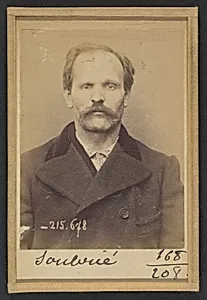
Soubrié. François. 39 ans, né à Livignac-le-Haut (Aveyron). Brûleur de café. Anarchiste. 14/3/94.
Medium
Albumen silver print from glass negative
Dimensions
10.5 x 7 x 0.5 cm (4 1/8 x 2 3/4 x 3/16 in.) each
Classification
Photographs
Department
Photographs
Museum
Metropolitan Museum of Art, New York, NY
Credit
Gilman Collection, Museum Purchase, 2005
Accession Number
2005.100.375.392
Rights
Public Domain
Tags
Art Historical Context
In the late 19th century, criminologist Alphonse Bertillon revolutionized police identification with his anthropometric system, pairing precise body measurements with standardized portrait photographs known as *portraits parlés* (speaking likenesses). This 1894 albumen silver from a glass negative captures François Soubrié, a 39-year-old coffee roaster (*brûleur de café*) from Livignac-le-Haut in Aveyron, labeled simply as "Anarchiste." Measuring just 10.5 x 7 cm, the small card-like image exemplifies Bertillon's meticulous mugshot format: a full-face view with exacting lighting and pose to aid criminal record-keeping. Bertillon's technique, blending science and photography, marked a pivotal shift from sketchy descriptions to empirical evidence, influencing modern forensics worldwide. The albumen process, using egg whites to bind silver salts on paper, yielded richly toned, detailed prints ideal for archival use during France's *Belle Époque* era of social unrest. This portrait, part of The Metropolitan Museum of Art's Gilman Collection, offers a poignant glimpse into the era's anarchist movement—fueled by labor struggles and political bombings in the 1890s. Soubrié's stern gaze humanizes the labeled "threat," reminding us how photography captured not just suspects, but the turbulent spirit of fin-de-siècle France.
About the Artist
Alphonse Bertillon · 1853–1914
Alphonse Bertillon (1853–1914) was a pioneering French photographer whose work revolutionized forensic documentation, transforming police identification into a precise visual science. Born in Paris on April 22, 1853, he was the son of medical professor and statistician Louis-Adolphe Bertillon and the younger brother of demographer Jacques Bertillon. Lacking formal higher education after expulsion ...