
Soup Dish
Unknown Artist
1815–30
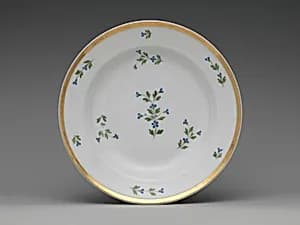
Medium
Porcelain
Dimensions
H. 1 3/4 in. (4.4 cm); Diam. 9 1/8 in. (23.2 cm)
Classification
Soup dish
Culture
French
Department
The American Wing
Museum
Metropolitan Museum of Art, New York, NY
Credit
Gift of Mrs. Alan W. Carrick, 1967
Accession Number
Inst.67.15.34
Rights
Public Domain
Art Historical Context
This delicate porcelain soup dish, crafted in France between 1815 and 1830, exemplifies the refined tableware of the post-Napoleonic era. Measuring just 1¾ inches high and 9⅛ inches in diameter, its shallow bowl and subtle curves were designed for elegant dining, reflecting the period's emphasis on graceful functionality in everyday luxury. Produced during France's Restoration and early July Monarchy, such pieces were often made at prestigious factories like Sèvres showcasing the technical mastery of porcelain—fired at high temperatures to achieve its signature translucency and durability. Porcelain's significance lies in its status as a symbol of sophistication, bridging art and domestic life. French makers perfected hard-paste porcelain techniques, allowing for intricate shapes and fine glazes that mimicked costlier Chinese imports while catering to Europe's growing middle and upper classes. This dish, though by an unknown artist, highlights how tableware became a canvas for national pride and cultural exchange. Housed in The Metropolitan Museum of Art's American Wing and gifted by Mrs. Alan W. Carrick in 1967, it underscores transatlantic tastes—likely imported to America, where French elegance influenced elite households. A quiet testament to 19th-century global trade, it invites visitors to appreciate the artistry in the ordinary.