
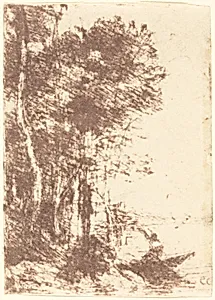
Souvenir of Fampoux (Souvenir de Fampoux)
Medium
cliché-verre
Classification
Department
CG-E
Museum
National Gallery of Art, Washington, D.C.
Credit
Print Purchase Fund (Rosenwald Collection)
Accession Number
1967.18.5
Rights
Public Domain
Art Historical Context
Step into the serene world of Jean-Baptiste-Cam Corot's *Souvenir of Famp (Souvenir de Foux)*, created in 1854. This evocative print captures the artist's fondness for the French countryside, likely evoking a peaceful village scene near Arras, where Fampoux is located. Corot, master of the Barbizon school and a bridge to Impressionism, infused his landscapes with poetic light and subtle atmosphere, blending realism with romantic introspection. What makes this work truly special is its medium: cliché-verre, a rare 19th-century hybrid technique. Corot drew directly on a glass plate with ink or paint, which was then contact-printed onto paper, producing unique, painterly effects akin to a photographic negative. This experimental method allowed artists like Corot to merge drawing's intimacy with printmaking's reproducibility, bridging traditional art and emerging photography during a time of technological innovation. Housed in the National Gallery of Art's Department of Prints (CG-E), acquired through the Print Purchase Fund from the Rosenwald Collection, *Souvenir of Fampoux* highlights Corot's versatility beyond oil paintings. It invites visitors to appreciate how 19th-century artists pushed boundaries, creating intimate "souvenirs" that preserve fleeting moments of beauty. (198 words)
About the Artist
Jean-Baptiste-Camille Corot · 1796–1875
Jean-Baptiste-Camille Corot, born on July 16, 1796, in Paris to a prosperous bourgeois family—his father a former wig-maker turned draper and his mother a successful milliner—was initially apprenticed in the textile trade but pursued art from his mid-twenties with family support. He studied under the neoclassical landscapist Achille Etna Michallon in 1821–1822, who taught him to sketch outdoors in...