
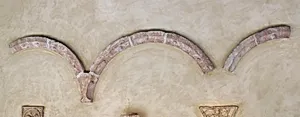
Spandrel with Sections of an Arch
Unknown Artist
ca. 1130–40
Medium
Marble
Dimensions
25.120.603: 17 1/4 × 13 1/2 × 10 in. (43.8 × 34.3 × 25.4 cm) 25.120.982: 7 3/4 × 29 1/4 in. (19.7 × 74.3 cm) 25.120.983: 6 3/4 × 29 1/2 in. (17.1 × 74.9 cm) 25.120.984: 6 1/4 × 27 1/4 in. (15.9 × 69.2 cm) 25.120.985: 6 1/2 × 23 1/2 × 10 1/2 in. (16.5 × 59.7 × 26.7 cm) 25.120.986: 6 1/2 × 18 1/2 × 10 in. (16.5 × 47 × 25.4 cm) 25.120.987: 6 × 20 1/2 × 8 in. (15.2 × 52.1 × 20.3 cm) 25.120.988: 6 3/4 × 31 1/4 × 7 1/2 in. (17.1 × 79.4 × 19.1 cm)
Classification
Sculpture-Architectural
Culture
Catalan
Department
The Cloisters
Museum
Metropolitan Museum of Art, New York, NY
Credit
The Cloisters Collection, 1925
Accession Number
25.120.603, .982–.988
Rights
Public Domain
Tags
Art Historical Context
This striking ensemble of marble fragments, known as *Spandrel with Sections of an Arch dates to around 1130–1140 and originates from Catalonia in northeastern Spain. Created during the height of the Romanesque period, these architectural sculptures once formed part of a larger decorative program—likely a church portal, arcade, or cloister—where rounded arches and spandrels framed sacred spaces. The Cloisters collection at The Metropolitan Museum of Art acquired the pieces in 1925, preserving them as rare survivors of medieval Catalan stonework. Carved from fine marble, the fragments reveal the skilled hand of an unknown artisan who balanced structural function with ornamental detail. The curved arch sections and triangular spandrels would have interlocked to create rhythmic patterns of light and shadow, guiding worshippers’ eyes toward the sacred interior. Such sculpture played a vital role in Romanesque churches, transforming heavy stone into a visual language of faith and craftsmanship. Today, these elements offer visitors a tangible connection to 12th-century Catalonia, where local workshops blended regional traditions with broader European influences. Their survival reminds us how architectural fragments can illuminate the grandeur of medieval buildings long after the original structures have changed or disappeared.