
Spechio di pensieri delle belle et Virtudiose donne, page 5 (verso)
1546
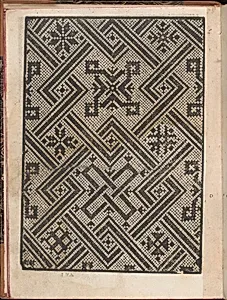
Medium
Woodcut
Dimensions
Overall: 8 1/16 x 5 7/8 in. (20.5 x 15 cm)
Classification
Books|Prints|Ornament & Architecture
Department
Drawings and Prints
Museum
Metropolitan Museum of Art, New York, NY
Credit
Harris Brisbane Dick Fund, 1937
Accession Number
37.54(9)
Rights
Public Domain
Tags
Art Historical Context
Welcome to the Metropolitan Museum of Art's Drawings and Prints department, where we encounter *Spechio di pensieri delle belle Virtudiose donne, 5 (verso)*, a delicate woodcut by Matteo Pagano from 1546. This page, measuring just 8 1/16 x 5 7/8 inches, hails from a Venetian Renaissance publication whose title translates to "Mirror Thoughts of Beautiful and Virt Women." Pagano, prominent printer and designer in mid-16th-century Venice crafted this as part of a book blending ornamentation with moralistic themes, celebrating feminine ideals through elegant designs. Woodcuts like this were revolutionary for their time, allowing intricate patterns to be reproduced affordably in books—a hallmark of Venice's printing boom. Classified under Ornament & Architecture, page 5 (verso) likely features decorative motifs inspired by classical architecture and scrolling foliage, reflecting the era's fascination with harmonious beauty and symmetry. These prints served as pattern books for artists, craftsmen, and readers alike, disseminating Renaissance aesthetics far beyond elite circles. Acquired through the Harris Brisbane Dick Fund in 1937, this work captures the cultural zeitgeist: a "mirror" not just for vanity, but for virtuous reflection amid Italy's artistic golden age. Pause here to appreciate how Pagano's precise carving turned humble wood into timeless elegance!
About the Artist
Matteo Pagano · 1515–1588
**Matteo Pagano (c. 1515–1588)** was a prominent Venetian printer, publisher, woodcut artist, and illustrator whose innovative designs bridged fine art and the decorative crafts during the Renaissance. Little is known about his early life, which remains sparsely documented, but he began his career as a woodblock cutter, working for the publisher Nicolò Zoppino on pattern books before establishing ...