
Specialities of Bizen Province
19th century
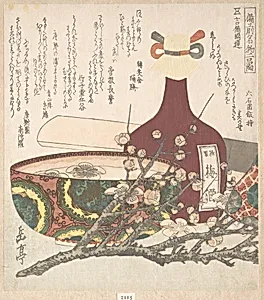
Medium
Woodblock print (surimono); ink and color on paper
Dimensions
8 1/16 x 7 3/16 in. (20.5 x 18.3 cm)
Classification
Prints
Culture & Period
Japan · Edo period (1615–1868)
Department
Asian Art
Museum
Metropolitan Museum of Art, New York, NY
Credit
H. O. Havemeyer Collection, Bequest of Mrs. H. O. Havemeyer, 1929
Accession Number
JP2115
Rights
Public Domain
Tags
Art Historical Context
**Specialities of Bizen** is a delicate woodblock print (surono) by Yashima Gakutei, a prolific Japanese artist of the late Edo period (5–1868). in the 19th century, this work measures just 8 1/16 x 7 3/16 inches, exemplifying the luxurious surimono tradition—privately commissioned prints often produced for poetry circles or New Year's greetings. Gakutei, known for his refined ukiyo-e style, captures the essence of Bizen Province (-day Okayama), a region celebrated for its natural and cultural bounty, with flowers as a prominent motif symbolizing local specialties. The print's medium—ink and color on paper—showcases masterful woodblock techniques, including vibrant pigmentation and precise carving that allowed for subtle gradients and textures. Surimono like this were artisanal treasures, sometimes enhanced with mica or embossing for a tactile allure, reflecting Edo Japan's vibrant print culture amid urban prosperity and regional pride. Housed in the Metropolitan Museum of Art's Asian Art department as part of the H. O. Havemeyer Collection, this piece invites visitors to appreciate how such works bridged poetry, nature, and place. Gakutei's elegant composition not only highlights floral beauty but also evokes the harmonious worldview of Edo-era Japan, making it a charming window into a bygone artistic golden age.
About the Artist
Yashima Gakutei · 1786–1868
Yashima Gakutei (c. 1786–1868), born in Osaka as the illegitimate son of a Tokugawa shogunate samurai named Hirata, adopted the name from his mother's subsequent marriage into the Yashima clan. Little is documented about his early years beyond these familial ties, but he pursued artistic training under the esteemed ukiyo-e masters Totoya Hokkei and Katsushika Hokusai, absorbing their precision in ...