
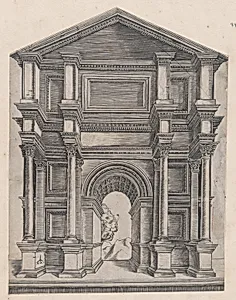
Speculum Romanae Magnificentiae: Arch by Master GA with the Caltrop
16th century
Medium
Engraving
Dimensions
sheet: 10 1/16 x 7 1/2 in. (25.5 x 19 cm)
Classification
Prints
Department
Drawings and Prints
Museum
Metropolitan Museum of Art, New York, NY
Credit
Harris Brisbane Dick Fund, 1941
Accession Number
41.72(1.84)
Rights
Public Domain
Tags
Art Historical Context
Step into the grandeur of ancient Rome through *Speculum Romanae Magniae: Arch by Master with the Caltrop a captivating 16th-century engraving the enigmatic Monogrammist G.A. & the Caltrop. This print, measuring 10 1/16 x 7 1/2 inches, captures the majestic form of a Roman arch, showcasing the enduring splendor of the city's architectural legacy. Part of the renowned *Speculum Romanaeificentiae*—a celebrated series compiled by publisher Antonio Lafreri—this work belongs to a vast collection of over 500 prints that documented Rome's ancient monuments during the Renaissance. Engraving, the medium here, was revolutionary for its precision: artists incised intricate lines into copper plates, inking them to produce detailed, reproducible images that could be shared across Europe. This technique allowed Monogrammist G.A., identified by his distinctive caltrop mark, to render architectural details with remarkable fidelity, from ornate carvings to structural elegance. Such prints were not mere illustrations but vital tools for scholars, architects like Andrea Palladio, and artists studying classical proportions. Housed in the Metropolitan Museum of Art's Drawings and Prints department (Harris Brisbane Dick Fund, 1941), this piece highlights Rome's cultural magnetism in the 16th century. It fueled the Renaissance revival of antiquity, inspiring designs that shaped Western architecture for centuries. A window to imperial magnificence, it invites us to marvel at Rome's timeless allure.
About the Artist
Monogrammist G.A. & the Caltrop · 1535–1535
**Monogrammist G.A. with the Caltrop**, an enigmatic Italian engraver active in Rome during the 1530s and 1540s, remains one of the shadowy figures of the Renaissance print world. Identified solely by his monogram "G.A." accompanied by a distinctive caltrop symbol—a spiked iron ball used in warfare—little is known of his personal life or training. His early years are not well documented, and no te...