
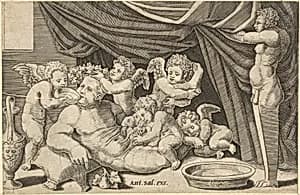
Speculum Romanae Magnificentiae: Bacchus Surrounded by Putti with Priapus holding back the curtain
Medium
Engraving
Dimensions
sheet: 4 3/4 x 7 3/16 in. (12 x 18.3 cm) mount: 17 5/16 x 10 5/8 in. (44 x 27 cm)
Classification
Prints
Department
Drawings and Prints
Museum
Metropolitan Museum of Art, New York, NY
Credit
Harris Brisbane Dick Fund, 1941
Accession Number
41.72(2.152)
Rights
Public Domain
Tags
Art Historical Context
This enchanting 16th-century engraving, titled *Speculum Romanae Magniae: Bacchus Sur by Putti with Pri Holding Back the Curtain*, captures the exuberant spirit of classical mythology. Part of the renowned *Speculum Romanae Magniae*—a celebrated series of prints compiled by Antonio Salamanca that celebrated Rome's ancient grandeur—this work draws on designs attributed to Raphael (Raffaello Sanzio Urbino), with masterful engraving by the Master of the. Produced during the Renaissance, when artists eagerly revived Greco-Roman themes, it reflects the era's fascination with antiquity amid Rome's rediscovery of its imperial past. At its center, the god Bacchus (the Roman Dionysus) revels amid playful putti—chubby, winged cherubs symbolizing innocence and joy—some sipping wine, others fluttering with butterflies, evoking themes of revelry, fertility, and nature's delights. Priapus, the phallic god of gardens and livestock, dramatically draws back a curtain, revealing the scene like a theatrical unveiling. The intimate sheet size (4 3/4 x 7 3/16 inches) made such prints affordable treasures for collectors, disseminating Raphael's graceful High Renaissance style through the precise, tonal techniques of copperplate engraving. Housed in the Metropolitan Museum of Art's Drawings and Prints department (Harris Brisbane Dick Fund, 1941), this piece highlights how prints democratized art, bridging ancient myths with Renaissance humanism and inviting viewers to toast to eternal pleasures.