
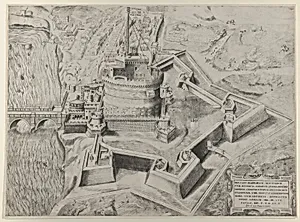
Speculum Romanae Magnificentiae: Castello Sant' Angelo
1557
Medium
Engraving and etching
Dimensions
sheet: 12 3/8 x 16 3/4 in. (31.5 x 42.5 cm)
Classification
Prints
Department
Drawings and Prints
Museum
Metropolitan Museum of Art, New York, NY
Credit
Harris Brisbane Dick Fund, 1941
Accession Number
41.72(3.41)
Rights
Public Domain
Tags
Art Historical Context
This engraving and etching by Giulio de Musi captures the imposing silhouette of Rome’s Castello Sant’Angelo and its adjacent bridge, as they appeared in 1557. Originally Hadrian’s mausoleum, the fortress had long served as a papal stronghold and refuge, its cylindrical mass and fortified walls standing as enduring symbols of both imperial and ecclesiastical power. The print belongs to the celebrated series Speculum Romanae Magnificentiae (“Mirror of Roman Magnificence”), a sixteenth-century publishing venture that assembled views of the city’s ancient and modern monuments for an international audience eager to possess images of Rome’s grandeur. Musi’s precise line work, achieved through the combined techniques of engraving and etching, allowed him to render architectural detail with remarkable clarity while suggesting the play of light across stone surfaces. Such prints were not merely documentary; they helped shape European perceptions of Rome as the living embodiment of classical civilization and Renaissance renewal. Acquired by the Metropolitan Museum through the Harris Brisbane Dick Fund, this sheet remains a vivid reminder of how printmaking disseminated knowledge of the Eternal City far beyond its walls.