
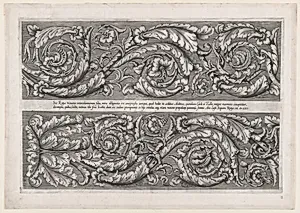
Speculum Romanae Magnificentiae: Della Valle Frieze
Medium
Engraving
Dimensions
sheet: 13 1/2 x 19 1/8 in. (34.3 x 48.5 cm) plate: 11 7/16 x 17 1/8 in. (29 x 43.5 cm)
Classification
Prints
Department
Drawings and Prints
Museum
Metropolitan Museum of Art, New York, NY
Credit
Harris Brisbane Dick Fund, 1941
Accession Number
41.72(3.3)
Rights
Public Domain
About this artwork
Speculum Romanae Magnificentiae: Della Valle Frieze by Anonymous|Antonio Lafreri|Antonio Lafreri, 1561. Created in Engraving, this work exemplifies the artistic practices and cultural values of its period. The piece reflects the technical skills and aesthetic sensibilities characteristic of its historical and cultural context. As part of the Drawings and Prints collection, it contributes to our understanding of artistic development and cultural expression. The work serves as both an aesthetic ob...
Art Historical Context
This engraving, created in 1561 by publisher Antonio Lafreri, belongs to the influential series known as the *Speculum Romanae Magnificentiae* ("Mirror of Roman Magnificence"). Produced during the height of the Renaissance, it records a classical frieze once housed in Rome’s celebrated Della Valle collection. As one of many prints issued by Lafreri, the work helped spread knowledge of ancient Roman sculpture across Europe at a time when scholars and collectors were eagerly rediscovering the city’s classical heritage. Rendered in precise engraving, the print captures the rhythmic procession of figures and ornamental motifs typical of Roman relief sculpture. Such reproductive prints served both as scholarly documents and as affordable souvenirs for visitors to Rome. By translating three-dimensional stone into fine black-and-white line, Lafreri’s workshop preserved details of the original frieze while making its beauty accessible far beyond the Della Valle palace. Today this sheet in the Metropolitan Museum’s collection reminds us how Renaissance printmakers bridged antiquity and their own era, turning Rome’s past into a shared visual language that continues to shape our appreciation of classical art.
About the Artist
Anonymous|Antonio Lafreri|Antonio Lafreri
In the vast tapestry of art history, "Anonymous" stands not as a singular individual but as a collective designation for countless unidentified creators whose works have endured across millennia. These artists, spanning prehistoric cave painters to medieval illuminators and folk craftsmen, produced the foundational layers of human visual culture. Prior to the Renaissance, when individual fame emer...