
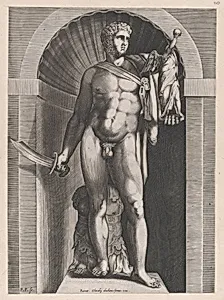
Speculum Romanae Magnificentiae: Diomedes with the Palladium in his left hand
Medium
Engraving
Dimensions
sheet: 13 7/16 x 9 13/16 in. (34.2 x 25 cm) mount: 17 1/4 x 12 7/16 in. (43.8 x 31.6 cm)
Classification
Prints
Department
Drawings and Prints
Museum
Metropolitan Museum of Art, New York, NY
Credit
Harris Brisbane Dick Fund, 1941
Accession Number
41.72(2.110)
Rights
Public Domain
Tags
Art Historical Context
This striking engraving, *Speculum Romanae Magnificentiae Diomedes with the Palladium in his left hand (1582), is a collaboration between Flemish engraver Pieter Perret and Roman publisher Claudio Duchetti. 13 7/16 9 13/16 inches on the sheet, it captures the muscular nude figure of the Greek hero Diomedes the sacred Palladium—a wooden statue of Athena believed to protect Troy—in a dynamic pose inspired by classical antiquity. Part of the renowned *Speculum Romanae Magniae* series, this print served as a "mirror" of Rome's ancient splendor during the Renaissance. Produced in the bustling print workshops of 16th-century Rome, these engravings faithfully reproduced famous sculptures from sites like the Capitoline Hill, making the glories of imperial Rome accessible to scholars, artists, and collectors across Europe. Duchetti's publishing house churned out over 600 such plates, fueling the era's fascination with Greco-Roman mythology and heroism. Engraving's fine lines allowed Perret to convey the sculpture's anatomical precision and dramatic tension, highlighting Diomedes' role in stealing the Palladium to ensure Troy's fall—a tale from Virgil's *Aeneid*. Now in the Metropolitan Museum of Art's Drawings and Prints department (Harris Brisbane Dick Fund, 1941), it exemplifies how prints democratized classical art, inspiring Baroque sculptors and preserving vanished antiquities for modern eyes.