
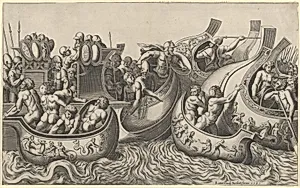
Speculum Romanae Magnificentiae: Naval Battle
16th century
Medium
Engraving
Dimensions
sheet: 9 7/16 x 15 3/8 in. (24 x 39 cm)
Classification
Prints
Department
Drawings and Prints
Museum
Metropolitan Museum of Art, New York, NY
Credit
Harris Brisbane Dick Fund, 1941
Accession Number
41.72(2.123)
Rights
Public Domain
Tags
Art Historical Context
Welcome to the Metropolitan Museum of Art's Drawings and Prints department, where you'll find *Speculum Romanae Magnificentiae: Naval Battle*, captivating 16th-century measuring 9 7/16 x 15 3/8 inches. Part of the renowned *Speculum Romanae Magnificentiae* ("Mirror of Roman Magnificence") series, compiled by Antwerp publisher Antonio Lafreri, this print vividly captures the drama of a naval clash amid ancient Roman grandeur. Swarming boats, fierce soldiers, and dynamic male nudes evoke the epic scale of classical warfare, blending historical fantasy with Renaissance fascination for antiquity. Attributed to the collaborative talents of the Master of the Die, Giulio Romano—a leading Mannerist artist known for his bold compositions and mythological flair—and publisher Claudio Duchetti, the work exemplifies the era's engraving techniques. Copperplate engraving allowed for intricate details, sharp lines, and mass reproduction, making such images accessible to scholars, collectors, and travelers across Europe. This medium fueled the 16th-century revival of Roman history, turning prints into portable "souvenirs" of the Eternal City. Culturally, these prints symbolized Rome's enduring magnificence during the High Renaissance, inspiring architects and artists like Michelangelo. Donated via the Harris Brisbane Dick Fund in 1941, this piece invites you to ponder how engravings preserved and popularized the classical past, bridging ancient battles to modern imaginations.
About the Artist
Master of the Die|Giulio Romano|Claudio Duchetti · 1525–1560
**Master of the Die** (fl. 1525–1560) was an anonymous Italian engraver and printmaker active primarily in Rome during the mid-16th century. Named for the distinctive small die he used to sign his prints—a tiny emblematic mark that became his moniker—this elusive artist remains unidentified despite scholarly proposals linking him to figures like Benedetto Verino, Giovanni Francesco Zabello, Tommas...