
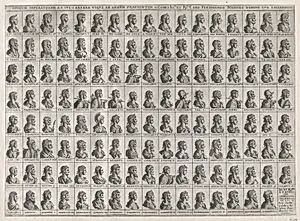
Speculum Romanae Magnificentiae: Portraits of the Emperors from Julius Caesar to Rudolf II
Medium
Engraving
Dimensions
sheet: 16 7/8 x 22 1/8 in. (42.9 x 56.2 cm) plate: 13 15/16 x 19 1/8 in. (35.4 x 48.5 cm)
Classification
Prints
Department
Drawings and Prints
Museum
Metropolitan Museum of Art, New York, NY
Credit
Harris Brisbane Dick Fund, 1941
Accession Number
41.72(3.97)
Rights
Public Domain
Tags
About this artwork
Allen & Ginter's '1st Base' from Girl Baseball Players series (N48, Type 2, 1886) represents pioneering intersection of women, sports, and commercial advertising. These albumen photograph cards measuring 2 3/4 x 1 3/8 inches were issued to promote Virginia Brights and Dixie Cigarettes. The series features two types: Type 1 shows female baseball players in polka dotted bib uniforms, often numbered; Type 2 depicts players in standard uniforms with position noted on image. In 1886, Allen & Ginter b...
Art Historical Context
Behold the *Speculum Romanae Magnificentiae: Portraits of the Emperors from Julius Caesar Rudolf II* (1582), a magnificent engraving crafted by Giovanni Ambrogio Brambilla, Claudio Duchetti and Antonio Lafreri. This expansive print, measuring nearly 17 by 22 inches on its sheet, showcases a gallery of imperial profiles spanning antiquity to the Renaissance. Beginning with Julius Caesar—whose iconic profile symbolizes the dawn of Roman dominance—and culminating with Rudolf II, the Holy Roman Emperor reigning in 1582, it traces a lineage of power across centuries. Part of the celebrated *Speculum Romanae Magnificentiae* ("Mirror of Roman Magnificence"), a series compiled by publisher Antonio Lafreri, this work reflects the 16th-century Renaissance obsession with classical antiquity. Produced in Rome, it bridged ancient Roman glory with contemporary Habsburg rule, affirming the enduring legacy of empire amid Europe's political upheavals. The tags highlighting "Julius Caesar Profiles" underscore the print's focus on these authoritative silhouettes, evoking coins and busts that immortalized leaders. As a fine example of Renaissance engraving, its intricate lines and large format allowed for detailed reproduction and wide dissemination, making classical history accessible to scholars and collectors. Housed in the Metropolitan Museum of Art's Drawings and Prints department (Harris Brisbane Dick Fund, 1941), this piece illuminates the era's cultural reverence for Rome, blending artistry with historical reverence in a single, awe-inspiring sheet.