
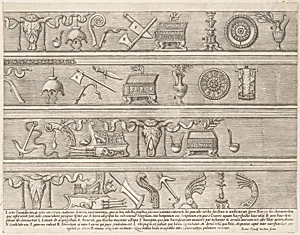
Speculum Romanae Magnificentiae: Sacrificial Instruments Based on Ancient Relief Sculpture
ca. 1550–75
Medium
Engraving.
Dimensions
sheet: 14 3/16 x 17 11/16 in. (36.1 x 45 cm). Wide margins around platemark.
Classification
Prints
Department
Drawings and Prints
Museum
Metropolitan Museum of Art, New York, NY
Credit
Harris Brisbane Dick Fund, 1941
Accession Number
41.72(3.15)
Rights
Public Domain
Tags
Art Historical Context
Step into the Renaissance fascination with ancient Rome through *Speculum Romanae Magniae: Sacrificial Instruments on Ancient Relief Sculpture*, exquisite engraving from around 1550–75. Created by master engravers Nicolas Beatrizet, Eneaico, and Claudio Du, this print belongs to a celebrated series compiled by publisher Antonio Lafreri in. Measuring 14 3/16 x 17 11/16 inches with generous margins, it captures the intricate details of ritual tools—knives, axes, skulls—drawn faithfully from classical Roman relief sculptures, evoking the solemnity of ancient sacrificial rites. Engraving, the medium here, was revolutionary for its precision and ability to reproduce fine lines on copper plates, making high-quality images of antiquities accessible beyond Italy's elite circles. These prints fueled the 16th-century revival of classical knowledge, inspiring artists, architects, and scholars during the height of humanism. Visitors would have pored over such folios in lavish albums, marveling at Rome's lost grandeur. Today, housed in the Metropolitan Museum of Art's Drawings and Prints department (acquired via the Harris Brisbane Dick Fund in 1941), this work bridges eras, reminding us how Renaissance creators meticulously revived the past to shape the future. A testament to art's power to preserve history!
About the Artist
Nicolas Beatrizet|Enea Vico|Claudio Duchetti · 1515–1566
Nicolas Beatrizet, born around 1515 in Lunéville, Lorraine (then part of the Holy Roman Empire), emerged as one of the most prolific French engravers of the 16th century. Little is known about his early life and training, with no records of specific teachers or apprenticeships, though regional influences from German and Italian printmaking likely shaped his skills before he arrived in Rome around ...