
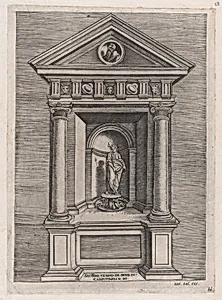
Speculum Romanae Magnificentiae: Temple-Altar of Jove, as a Youth
16th century
Medium
Engraving
Dimensions
sheet: 17 15/16 x 12 3/16 in. (45.5 x 31 cm) sheet: 11 1/4 x 8 1/4 in. (28.5 x 21 cm)
Classification
Prints
Department
Drawings and Prints
Museum
Metropolitan Museum of Art, New York, NY
Credit
Harris Brisbane Dick Fund, 1941
Accession Number
41.72(1.28)
Rights
Public Domain
Tags
Art Historical Context
This engraving, part of the renowned 16th-century series *Speculum Romanae Magnificentiae*, captures the Temple-Altar of Jove as a Youth, an evocative reconstruction of ancient Roman sacred architecture. Created through the collaborative efforts of engraver Marcantonio Raimondi and publisher Antonio Salamanca, the print exemplifies the Renaissance fascination with classical antiquity. Collectors and scholars across Europe acquired these images to study and celebrate Rome’s monumental past, long after many original structures had fallen into ruin. Raimondi’s precise engraving technique brings remarkable clarity to the temple’s columns, altar, and decorative details, allowing viewers to appreciate the grandeur of Roman design even from afar. Salamanca played a key role in compiling and disseminating such prints, transforming individual artworks into an accessible visual encyclopedia of the Eternal City. The result is both an artistic achievement and a cultural document that helped shape early modern understanding of Rome’s architectural legacy. Today housed in the Metropolitan Museum of Art’s Department of Drawings and Prints, this work continues to invite reflection on how Renaissance artists bridged antiquity and their own era through the enduring medium of engraving.
About the Artist
Marcantonio Raimondi|Antonio Salamanca · 1475–1534
Marcantonio Raimondi (c. 1480–1534), born near Bologna, Italy, emerged as one of the Renaissance's premier engravers, revolutionizing printmaking through his mastery of reproductive techniques. He trained in the workshop of the goldsmith, painter, and niellist Francesco Francia, whose influence is evident in his early engravings, such as the goldsmith-like shading in *Pyramus and Thisbe* (1505), h...