
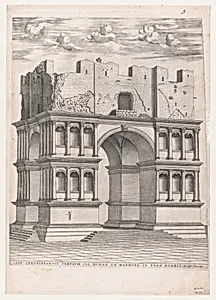
Speculum Romanae Magnificentiae: Temple of Janus
Medium
Engraving
Dimensions
sheet: 18 7/8 x 13 1/4 in. (48 x 33.7 cm) plate: 16 1/8 x 12 15/16 in. (41 x 32.8 cm)
Classification
Prints
Department
Drawings and Prints
Museum
Metropolitan Museum of Art, New York, NY
Credit
Harris Brisbane Dick Fund, 1941
Accession Number
41.72(1.30)
Rights
Public Domain
Tags
About this artwork
[Research in progress for Speculum Romanae Magnificentiae: Temple of Janus by Anonymous|Antonio Lafreri, 1564]
Art Historical Context
Created in 1564, this engraving from the *Speculum Romanae Magnificentiae* captures the Temple of Janus, one of ancient Rome’s most symbolically charged monuments. The print belongs to a celebrated series assembled by publisher Antonio Lafreri, whose workshop issued hundreds of views documenting the city’s classical ruins. Through precise line work typical of Renaissance engraving, the image records the temple’s distinctive double-faced archway, a structure whose doors were traditionally left open in times of war and closed only during peace. Lafreri’s project responded to a growing sixteenth-century fascination with Rome’s antiquities, offering visitors and scholars portable, affordable images of monuments that were often inaccessible or in ruins. Engravings such as this one played a vital role in circulating architectural knowledge across Europe, shaping both artistic imagination and the emerging discipline of archaeology. Today the sheet remains a vivid reminder of how printmaking helped preserve and reinterpret the legacy of ancient Rome for new generations.
About the Artist
Anonymous|Antonio Lafreri
In the vast tapestry of art history, "Anonymous" stands not as a singular individual but as a collective designation for countless unidentified creators whose works have endured across millennia. These artists, spanning prehistoric cave painters to medieval illuminators and folk craftsmen, produced the foundational layers of human visual culture. Prior to the Renaissance, when individual fame emer...