
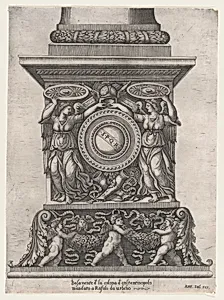
Speculum Romanae Magnificentiae: The Base of the Column of Theodosius
16th century
Medium
Engraving
Dimensions
sheet: 11 7/16 x 8 3/8 in. (29 x 21.2 cm)
Classification
Prints
Department
Drawings and Prints
Museum
Metropolitan Museum of Art, New York, NY
Credit
Harris Brisbane Dick Fund, 1941
Accession Number
41.72(1.113)
Rights
Public Domain
Tags
Art Historical Context
Step into the Renaissance fascination with ancient Rome through *Speculum Romanae Magnificent: The Base of the of Theodosius*, 16th-century engraving master engraver Marcantonio Raimondi and Antonio Salamanca. Part of the renowned *Speculum Romanae Magniae*—a lavish series of over 600 prints compiled in Rome—this work served as an illustrated catalog of the city's ancient wonders, eagerly collected by scholars, artists, and travelers during the humanist revival of classical antiquity. The print meticulously captures the ornate base of the Column of Theodosius, a late 4th-century victory monument erected by Emperor Theodosius I in Constantinople's Hippodrome to celebrate triumphs over barbarian foes. Adorned with intricate reliefs of shields, trophies, and figures, the base symbolized Roman imperial might and military glory. Tags like "Shields" and "Rome" highlight these decorative motifs, evoking the grandeur of a lost empire. Raimondi's precise engraving technique—renowned for its fine lines and tonal depth, often based on drawings by Raphael—allowed these fragile antiquities to be widely disseminated across Europe. Printed on a modest sheet (11 7/16 x 8 3/8 in.), it bridged ancient history and Renaissance curiosity, now preserved at The Metropolitan Museum of Art through the Harris Brisbane Dick Fund (1941). A window into how 16th-century minds rediscovered Rome's splendor!
About the Artist
Marcantonio Raimondi|Antonio Salamanca · 1475–1534
Marcantonio Raimondi (c. 1480–1534), born near Bologna, Italy, emerged as one of the Renaissance's premier engravers, revolutionizing printmaking through his mastery of reproductive techniques. He trained in the workshop of the goldsmith, painter, and niellist Francesco Francia, whose influence is evident in his early engravings, such as the goldsmith-like shading in *Pyramus and Thisbe* (1505), h...