
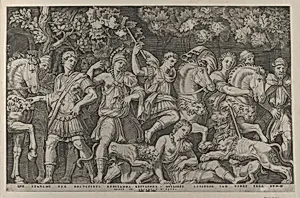
Speculum Romanae Magnificentiae: The Lion Hunt
ca. 1500–1534
Medium
Engraving
Dimensions
sheet: 10 1/4 x 16 in. (26.1 x 40.6 cm) mount: 14 15/16 x 16 3/4 in. (37.9 x 42.6 cm)
Classification
Prints
Department
Drawings and Prints
Museum
Metropolitan Museum of Art, New York, NY
Credit
Harris Brisbane Dick Fund, 1941
Accession Number
41.72(3.78)
Rights
Public Domain
Tags
Art Historical Context
Step into the Renaissance fascination with ancient Rome through *Speculum Romanae Magniae: The Lion Hunt an exquisite engraving by master printmaker Marcantonio Raimondi, published by Antonio Salamanca around 1500–1534. This work is part of the renowned *Speculum Romanae Magnificentiae series—"Mirror of Roman Magnific"—a vast collection of over 600 prints that captured the grandeur of Roman antiquities for eager collectors across Europe. Raimondi, a pioneer in reproductive engraving, skillfully translated classical motifs into precise, reproducible images, bridging antiquity and the Renaissance revival of classical learning. The scene bursts with dynamic energy: armored men on horseback pursue roaring lions in a thrilling hunt, evoking ancient Roman sarcophagi and mosaics that celebrated heroism and the wild spectacles of the empire. Engraving, Raimondi's specialty, allowed for intricate lines and rich tonal contrasts on a grand sheet measuring 10¼ x 16 inches, making these affordable luxury items for scholars and nobles. This medium democratized art, spreading Roman iconography far beyond Italy. Housed in the Metropolitan Museum of Art's Drawings and Prints department (Harris Brisbane Dick Fund, 1941), *The Lion Hunt* highlights how 16th-century artists like Raimondi fueled the humanist passion for Rome's past, blending historical reverence with technical virtuosity. A timeless window into epic tales of valor!
About the Artist
Marcantonio Raimondi|Antonio Salamanca · 1475–1534
Marcantonio Raimondi (c. 1480–1534), born near Bologna, Italy, emerged as one of the Renaissance's premier engravers, revolutionizing printmaking through his mastery of reproductive techniques. He trained in the workshop of the goldsmith, painter, and niellist Francesco Francia, whose influence is evident in his early engravings, such as the goldsmith-like shading in *Pyramus and Thisbe* (1505), h...