
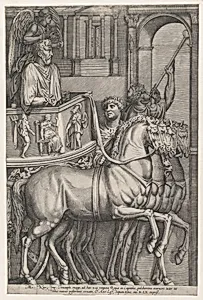
Speculum Romanae Magnificentiae: Triumph of Marcus Aurelius
Medium
Engraving; second state of two (Robert-Dumesnil)
Dimensions
sheet: 16 3/4 x 11 1/8 in. (42.5 x 28.2 cm) mount: 21 5/16 x 15 9/16 in. (54.2 x 39.5 cm)
Classification
Prints
Department
Drawings and Prints
Museum
Metropolitan Museum of Art, New York, NY
Credit
Harris Brisbane Dick Fund, 1941
Accession Number
41.72(2.131)
Rights
Public Domain
Tags
Art Historical Context
Created in 1560, this engraving belongs to Antonio Lafreri’s ambitious *Speculum Romanae Magnificentiae* (“Mirror of Roman Magnificence”), a celebrated series of prints that brought the grandeur of ancient Rome to a wide European audience. Nicolas Beatrizet, working for the Lafreri publishing house, rendered the triumphal procession of Emperor Marcus Aurelius with lively detail: musicians, soldiers, and captives accompany the emperor’s chariot drawn by four horses, evoking the pageantry of imperial victory parades. As a copperplate engraving, the work demonstrates the medium’s power to reproduce intricate compositions with remarkable clarity, allowing viewers far from Rome to study classical architecture, costume, and ceremonial ritual. The second state of the plate shows the careful refinements printmakers made to meet growing demand. Today housed in the Metropolitan Museum of Art, the sheet remains a vivid reminder of Renaissance fascination with antiquity and the role of prints in shaping historical imagination.
About the Artist
Antonio Lafreri|Nicolas Beatrizet|Antonio Lafreri · 1507–1577
Antonio Lafreri, born Antoine du Pérac Lafréry around 1512 in Orgelet in the County of Burgundy (modern-day France), emerged as one of the most influential print publishers of the 16th century after settling in Rome around 1540. His early life and training remain sparsely documented, with no records of specific teachers or art schools; he arrived in the Eternal City as an engraver, producing works...